


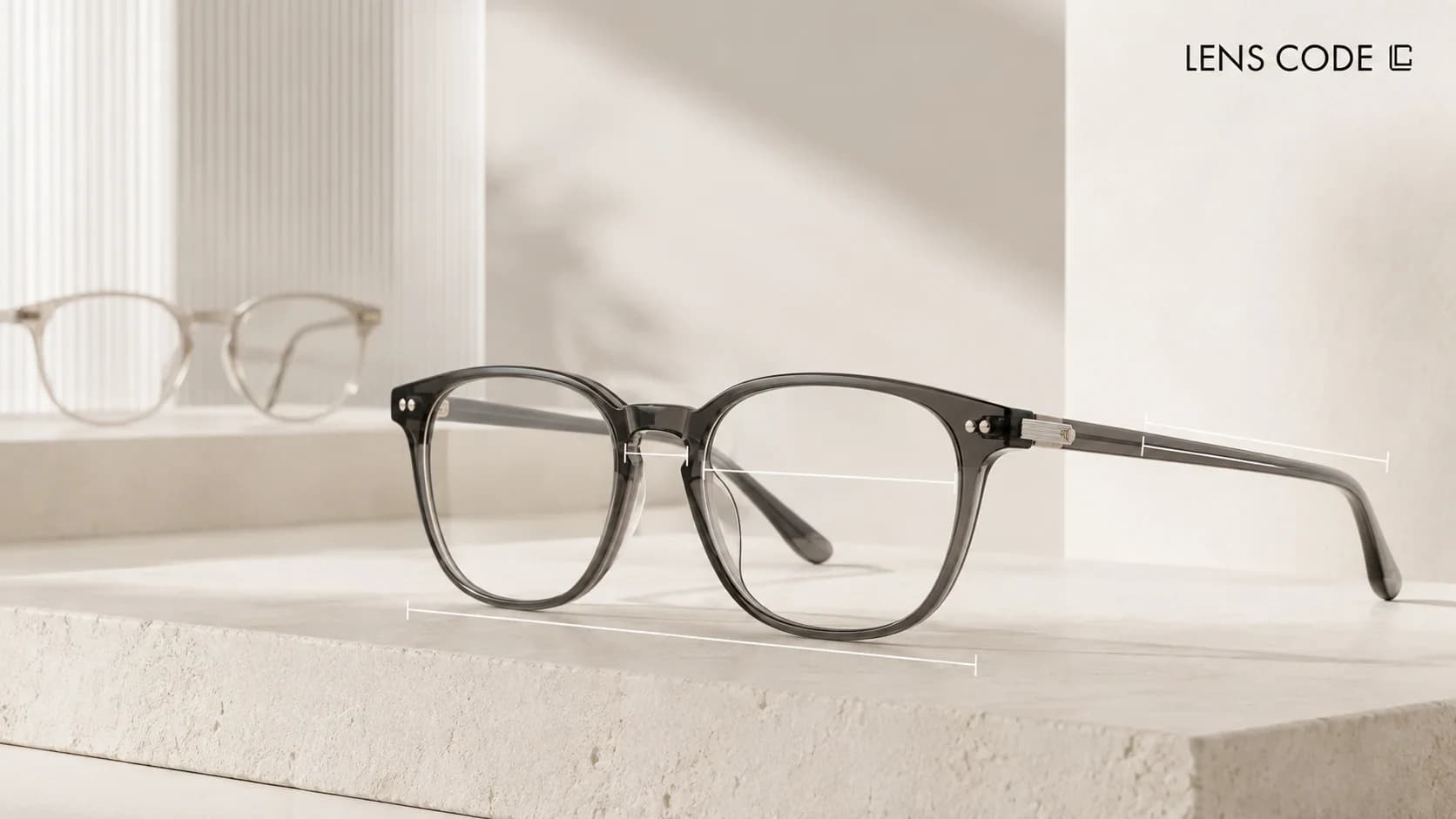
What 52-18-140 Means When Comparing Eyeglass Frame Sizes
If the inside of your frame says 52-18-140, start there. Those numbers describe three different frame measurements, and they give you a much better reference point than trying to judge size from a product photo.
If your current glasses already fit well, keep them beside you while you shop. You are not looking for three numbers that must match perfectly; you are looking for a new frame whose measurements and overall design make sense compared with something you already know.
- 52 mm: Lens Width — the horizontal width of one lens.
- 18 mm: Bridge Width — the measurement between the lenses at the bridge.
- 140 mm: Temple Length — the length of the side arm.
These measurements are expressed in millimetres. ISO 8624 defines the measuring system and vocabulary used for spectacle frames.
What does 52-18-140 mean on glasses?
The first number, 52, is the width of one lens. It is not the total width of the glasses. The second number, 18, describes the bridge measurement, and 140 is the temple length.
Think of them as three separate measurements rather than one size code. A 52 mm lens tells you one thing about the front of the frame, but it does not tell you how wide the entire frame will sit on your face.
Where can you find your frame size?
Check the inside of either temple arm first. LensCode's FAQ also points customers to the inner temple of their current glasses for numbers such as 54-18-140.
If you are comparing frames online, look at the technical specifications on the PDP. If a measurement is not listed, do not try to estimate it from the image.
How to use your current glasses when buying another frame
A comfortable pair you already own is usually the most practical starting point. Write down its lens width, bridge width and temple length, then compare those numbers with two or three frames in the LensCode eyeglasses collection.
- 1. Compare Lens Width.
- 2. Compare Bridge Width.
- 3. Compare Temple Length.
- 4. Check the overall frame shape and width.
- 5. Look at construction and bridge design before deciding.
The numbers do not need to match exactly. Small changes can feel different depending on the shape of the lenses, the bridge and the way the temples leave the front of the frame.
Lens Width is not the same as Frame Width
Lens Width measures one lens. Frame Width describes the full front of the glasses from side to side.
A frame marked 52-18-140 is not 52 mm wide overall. Do not calculate the finished frame width by simply adding the two lens widths and the bridge either; rims, hinges and side geometry also occupy space.
Construction is another separate detail. Full-rim, semi-rimless and rimless describe how the lenses are held, which is covered in Types of Eyeglass Frames.
Is frame size the same as PD?
No. Numbers such as 52-18-140 describe the frame. PD, or Pupillary Distance, measures the position of your pupils relative to each other.
The College of Optometrists describes PD as a facial measurement taken during the dispensing process. So 52 is not your PD and it is not an “eye size” measurement in the sense of measuring your eye itself.
Is there a universal Small Medium Large eyeglass size chart?
No universal S, M and L chart applies to every frame and every brand. Those labels can be useful inside one store or collection, but the millimetre measurements give you more precise information for direct comparison.
LensCode, for example, currently labels Mira as Medium while also listing the actual measurements as 51-17-144 mm. The numbers are the more useful part if you are comparing it with a frame you already wear.
Can two frames with the same Lens Width fit differently?
Yes. Two frames can both have a 52 mm lens width and still feel noticeably different. One may have a wider bridge, a deeper lens shape, thicker rims or a different temple angle.
Total width, bridge design, curvature and construction all affect how the frame sits. If the measurements are close and shape becomes your next filter, keep that decision separate with the LensCode face-shape article.
How can you tell if glasses are too big?
Repeated slipping, obvious movement when you walk, a front that extends well beyond the sides of your face or a bridge that does not sit securely are signs worth checking.
Slipping alone does not prove the frame is too large because adjustment can also matter. LensCode keeps the full troubleshooting intent in Signs Your Glasses Are Too Big for Your Face.
How can you tell if glasses are too small?
Pay attention to strong pressure at the sides of your head or nose, temples that do not reach comfortably behind the ears, or a frame front that feels noticeably tight. A longer temple does not fix a front that is too narrow.
Do sunglasses use the same measurements?
Yes. Sunglasses commonly use the same core measurements: lens width, bridge width and temple length. What may change is the visual scale, lens height, coverage and curvature of the design.
You can see this in the LensCode sunglasses collection. WAHAJ is listed at 51-16-145 mm, while FALCON is 53-14-140 mm. The numbers are read the same way even though the frame proportions and shapes differ.
Is frame size enough to choose glasses online?
No. Measurements narrow the shortlist, but they do not fully describe bridge shape, curvature, frame construction or how the finished glasses will sit on your face.
Use the numbers to remove obviously unsuitable options, then inspect the complete PDP rather than treating 52 or 54 as a final fit verdict.
What should you check with a stronger or complex prescription?
Avoid fixed rules such as “always choose below 50 mm.” Prescription power, lens material, frame dimensions and shape all interact in the finished lens thickness and weight.
ZEISS notes that frame size and shape can affect subsequent lens thickness and overall spectacle weight. If your prescription is driving the frame decision, use the LensCode prescription glasses article for that part of the process.
Compare real LensCode frame measurements
These are current measurements shown on the English product pages. The point is not to rank the frames, but to see how quickly the three numbers change from one model to another.
| Model | Lens Width | Bridge | Temple | Listed frame detail |
|---|---|---|---|---|
| Rosa | 48 mm | 18 mm | 143 mm | Round |
| Eva - Black | 51 mm | 21 mm | 145 mm | Semi Rimless |
| NOVA - Sky Blue | 52 mm | 18 mm | 140 mm | Rimless |
| Vio - Bronze | 52 mm | 19 mm | 140 mm | Rimless |
| Luca | 54 mm | 17 mm | 142 mm | Rectangular |
A real two-frame comparison
Compare NOVA at 52-18-140 with Vio at 52-19-140. Lens width and temple length match, while the listed bridge measurement changes by 1 mm.
That does not prove one will fit and the other will not. Bridge shape and the geometry of the finished front still matter. The measurements help you narrow the comparison; they do not replace it.
Keep a comfortable pair beside you and compare two or three frames before deciding on colour.
Compare LensCode EyeglassesOnline frame-size checklist
- 1. Read the measurements on a pair that already fits.
- 2. Compare Lens Width.
- 3. Compare Bridge Width.
- 4. Compare Temple Length.
- 5. Check overall frame width if the PDP provides it.
- 6. Compare the shape and construction.
- 7. Review front and side product images.
- 8. If you are comparing within YUVA, check each model rather than assuming the collection shares one size.
- 9. Review the online glasses buying checks and current LensCode terms and policies before ordering.
Frequently asked questions about frame measurements
What does 52-18-140 mean on glasses?
It usually means 52 mm lens width, 18 mm bridge width and 140 mm temple length.
Where is glasses size written?
Check the inside of a temple arm first. Product pages may also list the measurements in their specifications.
Is 52 mm the total frame width?
No. It refers to one lens width, not the complete width of the frame front.
Is eyeglass frame size the same as PD?
No. Frame numbers describe physical frame dimensions. PD is a separate facial measurement used during lens dispensing.
Is there a standard Small Medium Large glasses chart?
No universal chart applies to every brand and frame shape. Compare the actual millimetre measurements instead.
Do sunglasses use the same size numbers?
Yes. The same lens-width, bridge-width and temple-length measurements are commonly used, although coverage and curvature can make the finished fit feel different.
Use the numbers as a reference, then judge the complete frame.
Start Comparing FramesDid you find this article helpful?
Share it with your friends or family interested in optical care.
فريق LensCodeVerified
A team specialized in optical sciences and eye care, dedicated to providing the latest information and advice to help you choose the perfect glasses and contact lenses.