


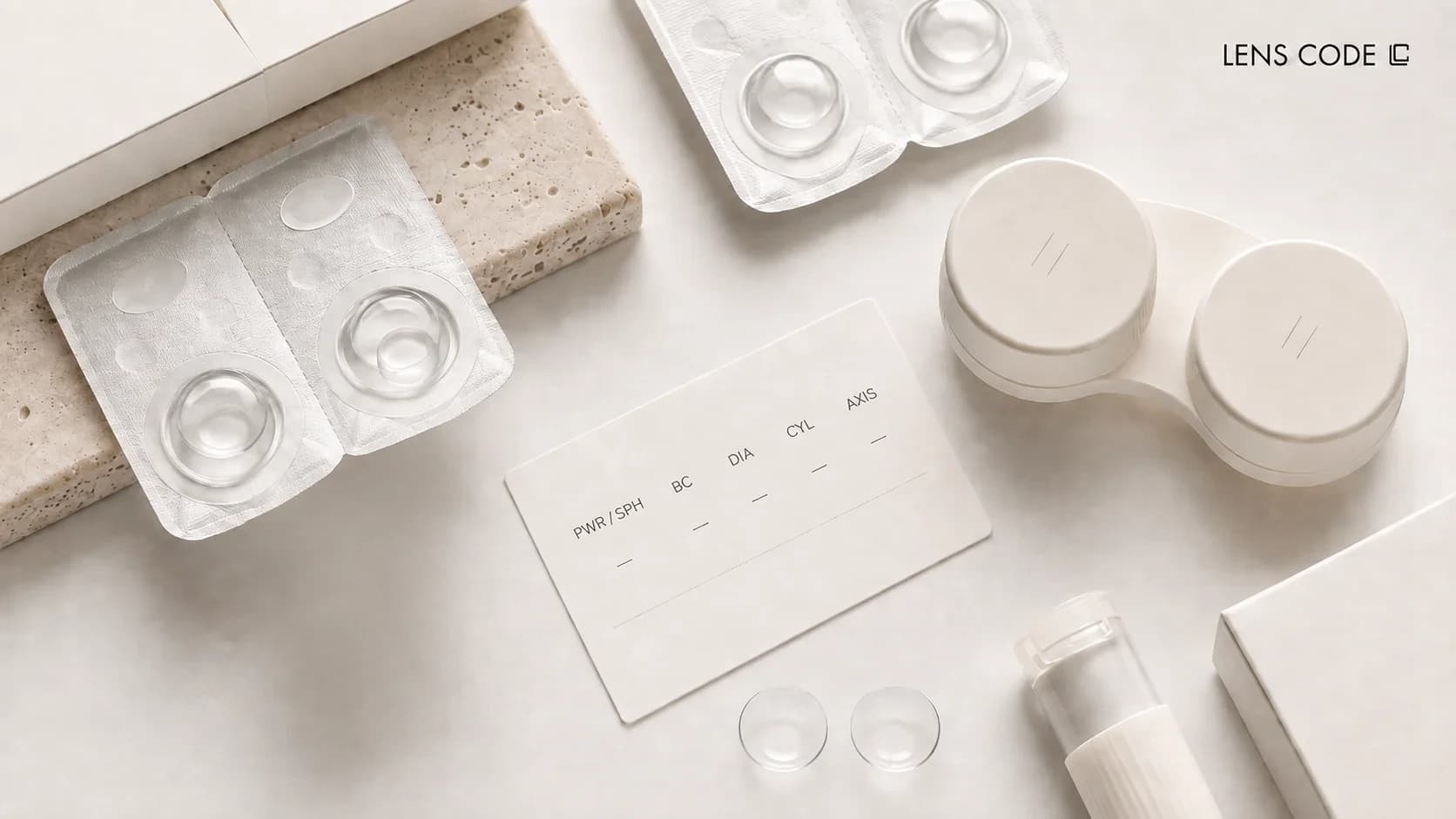
Prescription Contact Lenses: How to Choose the Right Lenses for Your Prescription and Routine
Choosing prescription contact lenses should not start with the brand or the biggest box. Start with an accurate contact-lens prescription, identify the type of correction you need, and then match the prescription and fitting parameters to the lens. Replacement schedule and pack size come after that.
Quick answer
Choose prescription contacts in this order: contact-lens prescription → correction type → prescription fields → fitting parameters → replacement schedule → matching product → pack size. Do not use a glasses prescription as a direct contact-lens order without the appropriate contact-lens fitting and prescription.
How do you choose prescription contact lenses?
Start with the lens that has been prescribed and fitted for your correction rather than comparing brands as interchangeable products.
Your decision has five main parts: prescription, correction type, fit parameters, replacement schedule and product match. Once those are clear, details such as box size become much easier to compare.
LensCode's Clear Contact Lenses collection is the most relevant starting point for current corrective lenses. If you need to see the wider range first, use the main Contact Lenses collection .
Is your glasses prescription enough to order contact lenses?
No. A glasses prescription and a contact-lens prescription should not be treated as interchangeable.
Spectacle lenses sit in front of your eyes, while contact lenses rest directly on the eye. A contact-lens prescription can also contain lens-specific information such as the prescribed product, Base Curve and Diameter, in addition to optical power.
Some numbers may look similar on both prescriptions, but that does not mean you should copy the SPH value from your glasses and use it to order contacts.
The American Optometric Association explains that glasses and contact-lens prescriptions may be similar but are not interchangeable.
What do the numbers on a contact lens prescription mean?
The exact fields depend on the correction you need. These are the main terms you may encounter when reviewing a prescription or matching a product.
| Field | Meaning | Why it matters |
|---|---|---|
| PWR / SPH | The spherical optical power, measured in diopters. | It provides the main vision correction for myopia or hyperopia when a spherical lens is prescribed. |
| CYL | Cylinder power used when astigmatism correction is required. | It is used with an appropriate lens design such as a toric contact lens. |
| AXIS | The orientation of cylinder correction, expressed in degrees. | CYL and AXIS work together when a toric correction is prescribed. |
| ADD | Additional near power used in some multifocal prescriptions. | It helps define the multifocal correction required for different viewing distances. |
| BC | Base Curve — a curvature parameter of the contact lens. | It is part of the lens fitting information rather than a cosmetic preference. |
| DIA | Diameter — the overall diameter of the lens. | It is a physical lens specification and varies between products. |
When checking an order, review more than power alone. The FDA contact-lens buying guidance specifically identifies brand, power or sphere, cylinder and axis when applicable, Diameter and Base Curve as details that may need to match.
Spherical, toric or multifocal contact lenses: what is the difference?
These terms describe different optical designs. The correct route depends on the correction in your prescription rather than which label sounds more advanced.
Spherical contact lenses
Spherical lenses provide standard spherical correction for myopia or hyperopia where that design matches the prescription.
Toric contact lenses
Toric lenses are designed for astigmatism correction. Their prescriptions commonly involve additional CYL and AXIS information. The American Academy of Ophthalmology identifies toric soft lenses as an option for correcting astigmatism.
Multifocal contact lenses
Multifocal lenses contain optical zones or powers intended to support vision across more than one distance, including options used for presbyopia when prescribed. An official Alcon multifocal lens guide provides examples of this correction type.
If your prescription contains CYL and AXIS or an ADD requirement, do not reduce the decision to the nearest spherical PWR. Match the lens design to the correction you have been prescribed.
Daily disposable or planned replacement?
Once the prescription and lens design are matched, compare the replacement schedule. This affects how the lens is used, cared for and packaged.
| Replacement type | Workflow | What to check |
|---|---|---|
| Daily disposable | Use a fresh lens for that day and discard it after use. | Prescription match, BC/DIA, pack quantity and wear instructions. |
| Planned replacement | Reuse the lens during its specified replacement cycle. | Prescription match, replacement interval, cleaning, disinfection and storage requirements. |
Saudi Ministry of Health guidance advises contact-lens wearers to install and replace lenses according to their schedule and to discard daily lenses at the end of the day. See the Saudi Ministry of Health contact-lens guidance .
Compare corrective lenses that match your prescription
Review the replacement schedule, BC, DIA and pack options before selecting the product prescribed for you.
Browse Prescription Contact LensesWhat does a 30-, 60- or 90-lens pack actually mean?
A pack count tells you how many individual lenses are supplied. It does not automatically tell you how many days the purchase will last.
The reason is simple: your right and left eyes may use different powers. If they do, you may need separate quantities for each prescription. The replacement schedule also changes how the lenses are consumed.
Acuvue 1-Day Moist is a daily lens at LensCode with 30-, 60- and 90-lens pack selections. Its current specifications list a Base Curve of 8.50 mm and Diameter of 14.20 mm, and the order flow allows the same power for both eyes or different power for each eye.
Dailies Total 1 follows a similar 30-, 60- and 90-lens pack architecture, with BC 8.5 mm and DIA 14.1 mm.
Can you switch contact lens brands if the power is the same?
Matching PWR alone does not make two contact lenses interchangeable.
Products can differ in lens material, design, Base Curve, Diameter and replacement schedule. A different model with the same spherical power can therefore still be a different fitting proposition.
If your contact-lens prescription or fitting identifies a particular product, do not switch simply because another brand offers the same numerical power. The AOA also notes that contact-lens products can use different materials and should not be treated as automatically interchangeable.
How to compare prescription contacts at LensCode
Once you know your prescribed correction, compare products on stable specifications rather than price alone: replacement schedule, BC, DIA, pack quantity, brand and eye-power selection.
| LensCode product | Replacement | BC | DIA | Pack options |
|---|---|---|---|---|
| Acuvue 1-Day Moist | Daily | 8.50 mm | 14.20 mm | 30 / 60 / 90 lenses |
| Dailies Total 1 | Daily | 8.5 mm | 14.1 mm | 30 / 60 / 90 lenses |
| Air Optix Plus HydraGlyde | Monthly | 8.6 mm | 14.2 mm | 6 / 12 / 18 lenses |
Air Optix Plus HydraGlyde gives a useful contrast to the two daily products: it is a monthly replacement lens, so its purchasing and care workflow is different. Pack count should still be considered only after confirming the lens and prescription match.
Prescription contact lens checklist before ordering
- ✓ Use a current and appropriate contact-lens prescription.
- ✓ Check the right-eye and left-eye values separately.
- ✓ Confirm whether the prescribed correction is spherical, toric or multifocal.
- ✓ Match PWR / SPH.
- ✓ Match CYL and AXIS when astigmatism correction is prescribed.
- ✓ Check ADD when it forms part of a multifocal prescription.
- ✓ Review BC and DIA and the prescribed product or model where relevant.
- ✓ Check the correct replacement schedule.
- ✓ Choose pack size after accounting for the prescription in each eye.
- ✓ Check the packaging and expiry date when your lenses arrive.
- ✓ Follow the lens-specific wear and care instructions.
The Saudi Food & Drug Authority advises contact-lens users to have vision assessed by an optometrist or specialist before purchasing and using lenses and to make sure the prescription matches the selected lens.
If you have an ordering or prescription-process question, visit the LensCode FAQ .
Common mistakes when buying prescription contacts
Using a glasses prescription directly
A spectacle prescription is not automatically a contact-lens prescription.
Checking only the power
PWR matters, but lens design and other prescribed or fitting parameters can matter as well.
Switching brands at random
The same numerical power does not mean the material, design, BC, DIA and fit are identical.
Treating a large pack as automatically better value
First check the prescription in each eye and how often the lens is replaced. Pack size comes after product matching.
Extending the replacement cycle
Do not reuse a daily disposable on another day or extend the specified replacement cycle of a reusable lens.
Ordering without an appropriate contact-lens fitting
Contact lenses sit directly on the eye, so product and fitting information matters alongside optical power.
A quick prescription contact lens decision framework
If several products look similar, reduce the decision in this order:
Start with your prescription, not the box
Compare LensCode's corrective lenses by replacement schedule, BC, DIA and pack size after confirming which lens matches your prescription.
Explore Prescription Contact Lenses❓ Frequently Asked Questions
Is a contact lens prescription different from a glasses prescription?
Yes. They should not be treated as interchangeable. Contact-lens prescriptions can include lens-specific fitting information and a prescribed product in addition to optical power.
How do I know what contact lens power I need?
Use the power on your current contact-lens prescription and the lens that has been appropriately fitted. Do not calculate contact-lens power from your glasses prescription yourself.
What does PWR or SPH mean on contact lenses?
PWR or SPH is the spherical optical power of the lens, measured in diopters. It provides the main correction when a spherical contact lens is prescribed.
Can I change contact lens brands if the power is the same?
Do not assume so. Different products may use different materials, designs, BC, DIA and replacement schedules, even when the power number is the same.
Do people with astigmatism need special contact lenses?
Astigmatism can be corrected with lens designs such as toric contact lenses when prescribed. A toric prescription commonly includes CYL and AXIS in addition to the main lens power.
Did you find this article helpful?
Share it with your friends or family interested in optical care.
فريق LensCodeVerified
A team specialized in optical sciences and eye care, dedicated to providing the latest information and advice to help you choose the perfect glasses and contact lenses.