


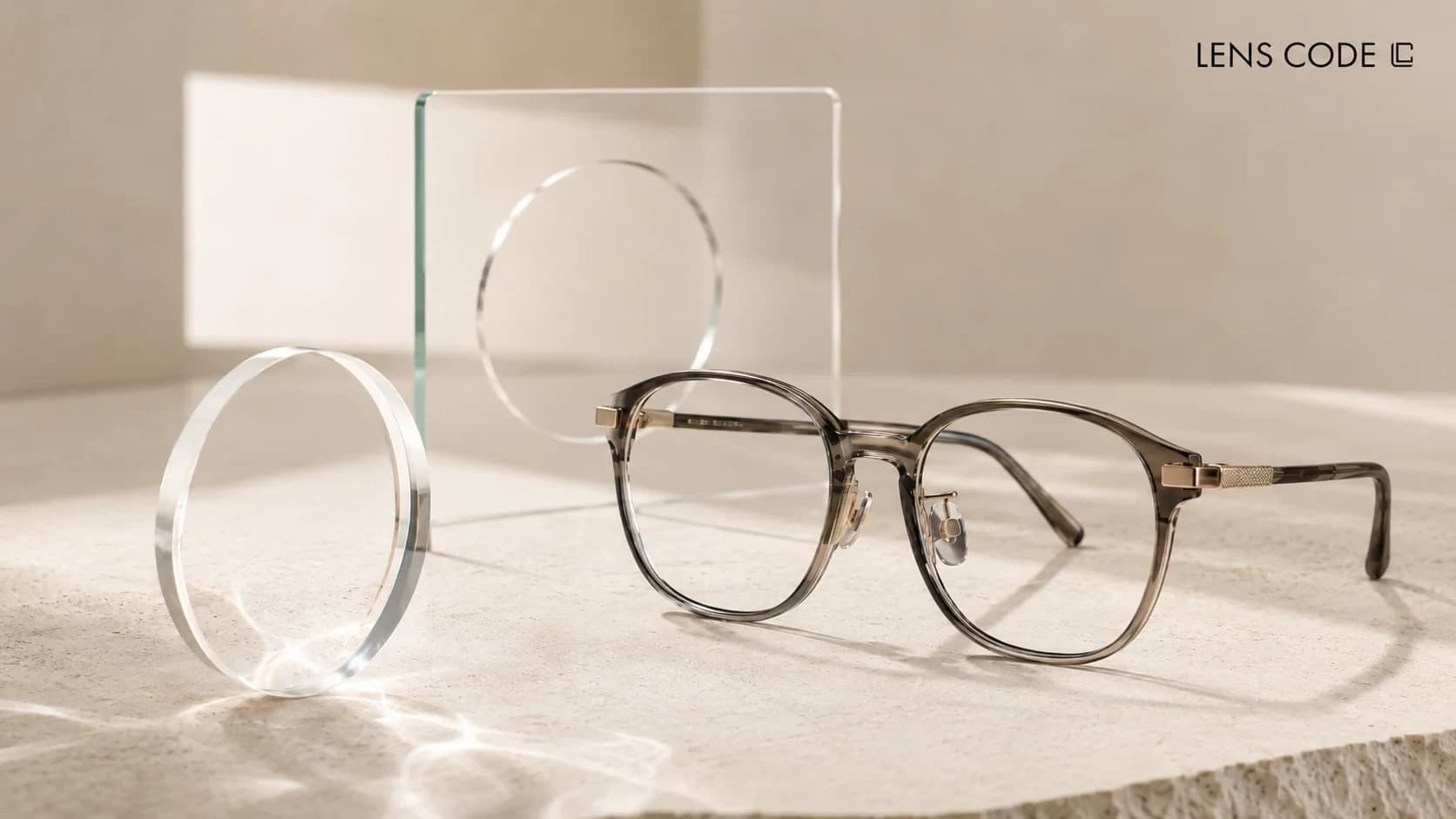
Do You Need Computer Glasses If Your Prescription Glasses Already Work?
If your current prescription glasses already give you clear, comfortable vision at your screen distance, working at a computer does not automatically mean you need a second pair. The better question is what your current lenses are designed to do at the distance where you actually work.
Computer glasses is a loose commercial term. One product may use a prescription designed around screen distance, another may use an office lens, and another may simply be a zero-power lens with blue-light filtering. Check the lens specification before treating the label as a lens type.
Prepared by: LensCode Team
The distinction in one minute
Provide vision correction according to a prescription and a chosen lens design.
A broad label for eyewear associated with screen or work distance. It may be prescription or non-prescription.
A lens filtering feature. It does not define the prescription or viewing distance of the glasses.
What is the actual difference between prescription glasses and computer glasses?
Prescription glasses start with the correction you need. Computer glasses are usually described by the task or viewing distance they are meant to serve. The two can overlap, but they are not interchangeable labels.
| Question | Prescription glasses | Computer glasses |
|---|---|---|
| Main starting point | Vision correction. | Screen or work task. |
| Do they have prescription power? | Yes, according to the prescription. | They may or may not. |
| Viewing distance | Depends on the prescribed lens design. | May prioritise screen or other work distances. |
| Blue-light filtering | May be available as a lens option. | May be present, but is not what defines computer glasses. |
For the broader prescription, frame and lens-selection process, keep that decision in the LensCode prescription glasses article .
Do computer glasses need a prescription?
Not always. Some products sold under the computer-glasses label have prescription power, while others are zero-power screen glasses with a filter or coating.
Can you use normal prescription glasses at a computer?
Often, yes. If your current lenses give you clear, comfortable vision at the screen distance you use, the presence of a monitor does not by itself create a need for another pair.
If you are replacing the frame as well, compare the measurements through the eyeglass size article before browsing the LensCode eyeglasses collection . Frame fit and screen-lens design are separate decisions.
Why does screen distance matter?
A computer screen often sits at a different distance from a book, phone or distant target. If the lens design you are wearing does not serve that working distance well, screen position becomes part of the optical decision.
Do not turn that into one universal screen-distance number. Workstations vary. If your day involves multiple monitors, documents and different viewing distances, use the dedicated office glasses article for the detailed workflow.
Computer glasses are not the same as blue light glasses
Computer glasses describe a task, distance or lens-design idea. Blue-light filtering describes what part of the visible spectrum a lens is designed to filter. Those are different questions.
- ✓ A prescription screen lens may include blue-light filtering.
- ✓ The same kind of screen lens may be configured without it.
- ✓ A zero-power blue-light lens may have no prescription correction.
- ✓ Blue Cut may also be offered as an option on regular prescription lenses.
If the filter itself is your main question, use the LensCode Blue Light Glasses article rather than turning this comparison into a Blue Cut guide.
What does the evidence say about blue-light filtering and eyestrain?
A 2023 Cochrane systematic review examined 17 randomised trials involving 619 participants. It found that blue-light-filtering spectacle lenses may provide little or no short-term reduction in visual fatigue associated with computer use compared with non-blue-light-filtering lenses.
That is why blue-light filtering should not be treated as the definition of computer glasses or as a proven standalone treatment for digital eye strain. The evidence and limitations are covered in more depth in the dedicated Blue Light article .
Anti-Reflection and blue-light filtering are different
Manages reflections from the surfaces of the lens. That optical function should not be rewritten as a promise to treat digital eye strain.
Filters selected blue wavelengths according to the lens technology. It does not tell you which working distance the lens is designed for.
LensCode's current lens FAQ lists basic anti-reflective treatment on prescription lenses and presents Blue Cut separately as an upgrade.
Are office lenses the same as everyday prescription glasses?
Not necessarily. Office or occupational lens designs can prioritise near and intermediate work distances according to the design being used. That makes them task-specific, not universally better than everyday lenses.
If that sounds closer to your situation, continue with the LensCode office-lens selection article .
Are reading glasses the same as computer glasses?
No general rule makes them interchangeable. A lens intended for close reading may not serve a screen positioned farther away in the same way. Do not choose a different reading power yourself simply to move the focus toward the monitor.
What about progressive lenses at a computer?
Progressive lenses provide more than one viewing zone. Screen height, working distance and the lens design can affect how easily you use the intermediate area. That does not mean progressive lenses are automatically unsuitable for computer work.
If you are changing head position repeatedly to find a clear zone, the office-work comparison is the better place to examine screen position and task-specific lens options.
Does digital eye strain mean you need computer glasses?
Not necessarily. Digital eye strain can have several contributors, including uncorrected vision, glare, viewing conditions, working distance, reduced blinking, dryness and posture.
If blur persists, vision changes or symptoms are significant, checking the underlying vision issue is more useful than assuming that a product labelled “computer glasses” is the answer.
Prescription problem or workstation problem?
| What you notice | What may be worth reviewing |
|---|---|
| Text stays blurred consistently | Vision and prescription accuracy rather than assuming Blue Cut is the fix. |
| Vision is clear but reflections are distracting | Lighting, glare and the anti-reflective lens treatment. |
| You raise your chin or move your head to find a clear zone | Screen position, working distance and lens design. |
| Your eyes feel dry after long screen sessions | Do not assume that new glasses alone address the cause. |
If you reach the ordering stage, use the LensCode online glasses checkout checklist to verify the prescription and frame details before payment.
What can you choose at LensCode?
Start with the frame as its own decision through the LensCode prescription-frame collection . The current prescription-ready PDPs we checked include a Choose Lens step.
LensCode's current prescription-lens information lists basic anti-reflective and scratch-resistant treatment and offers Blue Cut as a separate upgrade. That does not mean the resulting lens is automatically a task-specific computer prescription.
For the wider prescription workflow, use Best Prescription Glasses .
Compare real LensCode prescription frames
These are frame examples, not products that LensCode classifies as computer glasses. Compare the frame first; configure the lens separately.
| Model | Measurements | Verified frame detail | What it shows |
|---|---|---|---|
| NOVA - Sky Blue | 52-18-140 mm | Titanium, Rimless, Choose Lens available | Frame material and construction do not define the screen prescription. |
| Rival - Silver | 52-16-141 mm | Rimless, Choose Lens available | A similar lens width can still come with a different bridge and temple length. |
| Vio - Bronze | 52-19-140 mm | Rimless, prescription-lens compatible, Choose Lens available | Choose the frame for fit before deciding on screen-related lens features. |
| Luca | 54-17-142 mm | Rectangular metal frame; alloy not specified | Visual frame style and computer-lens design remain separate decisions. |
Use the frame measurement article if size is your next question, the frame materials article for material, and Types of Eyeglass Frames for construction.
Choose the frame for fit before choosing screen-related lens features
Compare the available frame specifications first, then move into the prescription and lens configuration.
Compare YUVA FramesDo you need a separate pair for work?
- Your current prescription glasses work comfortably at screen distance: a second pair is not automatically required.
- Your lens design does not serve your working distance well: review the task and distance rather than buying from the Computer Glasses label alone. Use the office glasses article for that decision.
- You are considering Blue Cut mainly because of an eyestrain claim: review the evidence first in the Blue Light article .
Frequently asked questions about computer glasses
What is the difference between computer glasses and prescription glasses?
Prescription glasses provide prescribed vision correction. Computer glasses is a broader term for eyewear intended around screen or work use and may be prescription or non-prescription.
Do computer glasses have a prescription?
Some do and some do not. Check the actual lens specification rather than relying on the product label.
Can I use prescription glasses for computer work?
Often yes, if they provide clear, comfortable vision at your working distance. Screen use alone does not require another pair.
Are computer glasses the same as blue light glasses?
No. Computer glasses refers to task or viewing use; blue-light filtering is a lens property that may or may not be included.
Do blue-light glasses reduce computer eyestrain?
Current randomised-trial evidence has not shown a clear short-term eyestrain advantage over non-blue-light-filtering spectacle lenses.
Are reading glasses suitable for a computer?
Not automatically. Reading and screen working distances can differ, so do not select a different reading power by guesswork.
A 60-second computer-glasses decision
Before ordering custom prescription lenses, also review the current LensCode prescription and custom-lens terms .
Start with the prescription and work distance, not the product label
Then compare the frame and the lens configuration as separate parts of the finished glasses.
Compare Prescription FramesDid you find this article helpful?
Share it with your friends or family interested in optical care.
فريق LensCodeVerified
A team specialized in optical sciences and eye care, dedicated to providing the latest information and advice to help you choose the perfect glasses and contact lenses.