


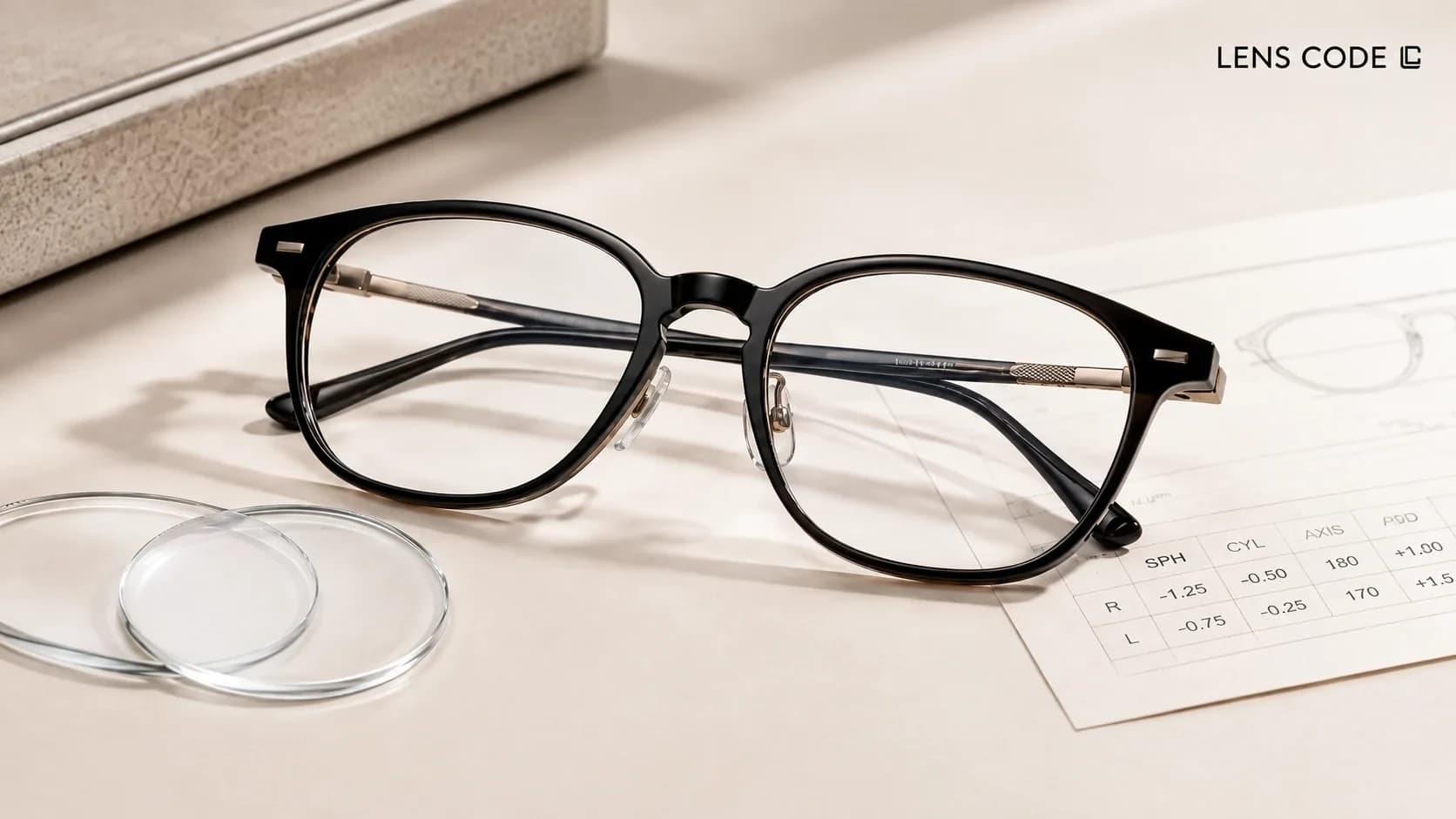
Best Prescription Glasses... How to Choose Frames and Lenses for Your Prescription
The best prescription glasses are not one frame or model that works for everyone. The right pair is the one that matches your prescription, frame fit, lens type and daily use. Style still matters, but it makes more sense to choose it after the optical and fit decisions are clear.
Quick answer
Start with an accurate prescription, compare the frame measurements with a pair that already fits you, choose a frame you are comfortable wearing, then select the lens type required for your vision needs. Review any lens options and prescription details before you place the order.
What makes prescription glasses right for you?
A useful way to judge prescription eyeglasses is: Prescription + Frame Fit + Frame + Lens Type + Daily Use.
Your prescription determines the vision correction you need. Frame measurements help you narrow down the fit. The frame affects how the glasses sit and feel, while the lens type determines how the prescription is delivered for the viewing distances you need.
Daily use completes the picture. Someone wearing glasses throughout the working day may prioritise fit and low frame weight differently from someone who mainly needs a pair for specific tasks. That does not make one frame universally better than another.
This is why searching for the best prescription glasses should lead to a decision process, not a generic top-ten list.
Start with your prescription, not the frame style
The frame is a shopping decision. Your prescription is optical information that needs to be accurate.
You can compare frame colours, shapes and designs yourself. Prescription numbers should not be guessed, changed or copied from memory because a different value seems more suitable.
The National Eye Institute explains that different refractive needs require different eyeglass lenses and that prescription lenses are used to provide the required vision correction.
LensCode's Terms & Policies also place responsibility on the customer for providing accurate prescription details and recommend submitting a current prescription from a licensed optometrist.
How to check your frame size
If you already own a comfortable pair of glasses, check the numbers printed on the inside of the temple. They give you a useful starting point for comparing a new frame.
Quick decision block: 54-18-140
- 54 mm: Lens Width
- 18 mm: Bridge Width
- 140 mm: Temple Length
Treat those measurements as a comparison point rather than a guarantee that every frame with identical numbers will fit in exactly the same way.
For a fuller explanation, use the LensCode eyeglass size guide instead of turning this article into a complete sizing tutorial.
| LensCode example | Frame detail | Measurements |
|---|---|---|
| Eilen - Silver | Rimless titanium eyeglasses | 48-21-140 |
| Mira | Geometric frame | 51-17-144 |
| Rosa | Round metal frame | 48-18-143 |
These examples are useful because they show how similar-looking eyewear can still differ in bridge width or temple length. The measurements help you compare; they do not rank one model above another.
If style is your next filter, keep that decision separate by using the LensCode face-shape guide . For a deeper material comparison, see the eyeglass frame materials guide .
Frame only or complete prescription glasses?
Buying the frame and ordering a complete pair of prescription glasses are two different purchase paths.
LensCode confirms that a Frame Only choice is available in some product journeys. This is useful when you want the frame without having prescription lenses configured as part of that order.
For complete prescription glasses, the frame becomes the starting point. Current LensCode product pages include a Choose Lens step, allowing the purchase journey to continue from the frame into lens configuration.
Ready to compare prescription frames?
Browse LensCode EyeglassesWhich lens type fits your prescription needs?
Single Vision, Progressive and Reading options should not be treated as three quality levels. They address different vision-correction needs.
| Lens type | General use | What the shopper should know |
|---|---|---|
| Single Vision | One viewing distance | Single Vision prescription lenses correct near vision or distance vision rather than both within the same lens design. |
| Progressive | More than one viewing distance | Progressive lenses are multifocal lenses with no visible dividing line between the near and distance areas. |
| Reading | Near tasks and close-up vision | Reading correction is intended for near vision needs and should be selected according to your actual prescription requirements. |
These definitions are consistent with guidance from the National Eye Institute , which distinguishes Single Vision from multifocal lenses and identifies Progressive lenses as a multifocal design without a visible line.
LensCode lists Single Vision, Progressive and Reading among its prescription customisation options. Choose the path that matches your prescription and visual needs rather than assuming that a more complex lens type is automatically better.
Anti-Reflection, Blue Cut and blue-light options: what is the difference?
The useful distinction here is between a lens feature and a medical claim.
| Option | What it means for your purchase |
|---|---|
| Anti-Reflection | LensCode states that its medical lenses include a basic anti-reflective option. |
| Blue Cut / blue-light filtering | A filtering option available within LensCode's lens selection journey. It should not be treated as a proven treatment for digital eye strain. |
For the medical evidence, a Cochrane systematic review found that blue-light filtering spectacle lenses may not reduce short-term eye strain associated with computer work compared with non-blue-light filtering lenses.
If you want the evidence in more detail, read LensCode's separate guide: Do blue-light lenses protect the eyes?
How LensCode prescription glasses are customised
The current LensCode journey connects the frame decision with prescription-lens configuration. Keep the process in this order:
Choose your frame
Start from the eyeglasses collection and open the product page for the frame you are considering.
Review the measurements
Product specifications show measurements such as lens width, bridge width and temple length.
Select the lens path
Prescription-ready product pages include a Choose Lens action that takes the purchase into lens configuration.
Provide your prescription details
LensCode's FAQ states that you can upload a photo of your prescription on the product page or send it through WhatsApp to the optician.
Review before ordering
Check the selected frame, measurements, lens type, options and prescription information before completing the order.
If you need clarification on prescription submission or current lens options, check the LensCode FAQ before placing the order.
Prescription glasses buying checklist
- ✓ Your prescription details are accurate and clear.
- ✓ You have checked lens width, bridge width and temple length.
- ✓ You have reviewed the actual product specifications, not the product photo alone.
- ✓ You know whether you are ordering the frame only or configuring prescription lenses.
- ✓ Your lens type matches the correction you need.
- ✓ You understand which lens options are product features and which claims require medical evidence.
- ✓ You have reviewed your complete configuration before ordering.
- ✓ You understand the return implications for custom-cut lenses by checking the current LensCode terms .
Common mistakes when buying prescription glasses online
Choosing a frame from the photo without checking measurements
Similar-looking frames can have different lens, bridge and temple measurements.
Guessing prescription values
A prescription should be treated as optical data, not as a setting to adjust by trial and error.
Treating lens types as quality tiers
Progressive is not automatically “better” than Single Vision. They are designed for different correction needs.
Assuming blue-light filtering guarantees less eye strain
Current systematic-review evidence does not support making that guarantee.
Ignoring custom-lens return conditions
LensCode's current FAQ states that custom-cut prescription lenses are non-refundable unless there is a manufacturing defect.
For a broader ecommerce checklist, see common mistakes when buying glasses online .
A simple decision framework
If the number of options starts to feel confusing, make one decision at a time:
Start with the frames, then configure the lenses
Compare frame measurements and designs in the LensCode collection, open the frame that fits your shortlist, then continue to its available lens options.
Explore LensCode EyeglassesFrequently Asked Questions
What are the best prescription glasses?
The best prescription glasses are the pair that matches your prescription, frame measurements, lens needs and daily use. There is no single frame or lens design that is right for everyone.
What is the difference between Single Vision and Progressive lenses?
Single Vision lenses correct vision for one viewing distance. Progressive lenses are multifocal lenses designed for more than one viewing distance without a visible dividing line.
Can I buy the frame only from LensCode?
LensCode confirms that a Frame Only option is available in some product journeys. Check the choices displayed for the specific frame before ordering.
Do Blue Cut lenses prevent digital eye strain?
They should not be treated as a proven way to prevent digital eye strain. A Cochrane systematic review found that blue-light filtering lenses may not reduce short-term eye strain associated with computer use compared with non-filtering lenses.
Can customised prescription lenses be returned?
According to LensCode's current FAQ, custom-cut prescription lenses are non-refundable unless there is a manufacturing defect. Check the current policy before ordering because the store policy is the final reference for your purchase.
Did you find this article helpful?
Share it with your friends or family interested in optical care.
فريق LensCodeVerified
A team specialized in optical sciences and eye care, dedicated to providing the latest information and advice to help you choose the perfect glasses and contact lenses.