


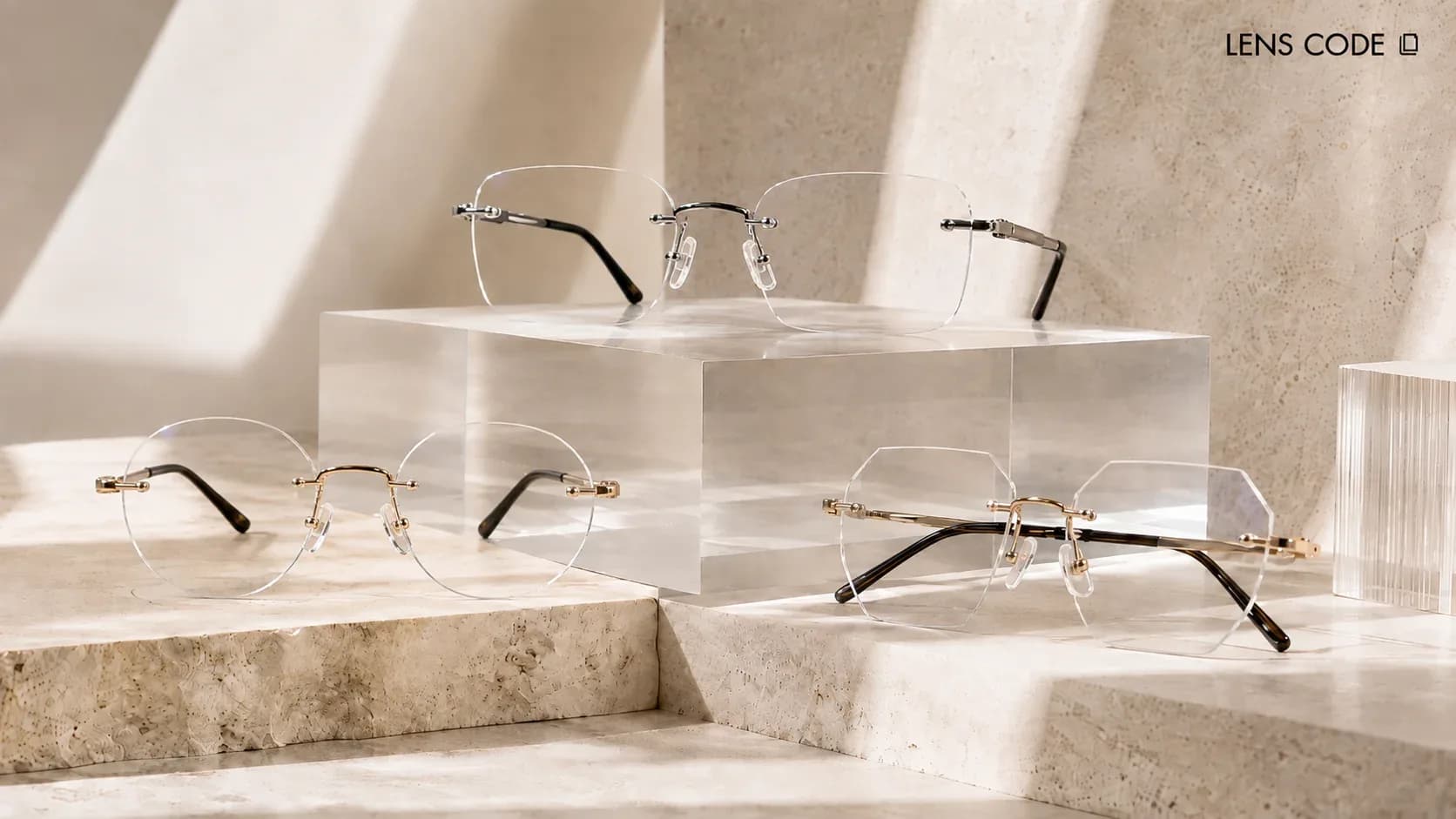
Rimless Glasses: Are They Right for You and How Should You Choose a Pair?
A rimless frame removes most of the visible structure around the lenses, but that makes the lenses themselves more relevant to the finished pair. Before choosing rimless glasses, check more than colour and shape: your prescription, lens compatibility, mounting system and frame measurements all matter. You can compare current options in the LensCode prescription eyeglasses collection as you narrow your shortlist.
Quick answer
Rimless or frameless glasses have no complete frame surrounding the lenses. They can work with prescription lenses, but suitability should be checked against the prescription, lens design, material and mounting system used by the specific frame. There is no useful universal prescription cutoff that applies to every rimless model.
What are rimless glasses?
Rimless glasses are eyeglasses without a complete frame rim around the lenses. Instead, the bridge and temples connect directly to the lenses through the mounting system used by the model.
You may also see the phrase frameless glasses. In eyewear shopping, both terms are commonly used for the same broad construction style, although the exact mounting hardware can differ between products.
Current LensCode inventory includes several YUVA rimless models. You can browse the wider YUVA eyeglasses collection or start from all prescription frames if you want to compare rimless with other constructions.
Rimless vs semi-rimless: what is the difference?
| Factor | Rimless | Semi-rimless |
|---|---|---|
| Frame around lens | No complete surrounding rim | Part of the lens remains supported by visible frame structure |
| Visual presence | Less visible structure around the lenses | More of the frame remains visible |
| Lens role | The lens participates directly in the mounting system | The frame provides partial surrounding support |
| What to check | Lens compatibility, mounting and measurements | Construction, measurements and lens compatibility |
That is enough distinction for a rimless buying decision. If you want the broader explanation of frame constructions and materials, use the LensCode frame materials guide rather than treating this as another full-rim versus semi-rimless guide.
Why do shoppers choose rimless glasses?
The most obvious difference is visual. With no complete rim surrounding the lenses, there is less frame structure around the eyes, and the shape of the lens itself becomes a larger part of the design.
Do not turn that into a claim that every rimless pair is automatically lighter or more comfortable. Finished weight depends on the lenses, bridge, temples, material and dimensions, while comfort depends heavily on fit and adjustment.
A product such as NOVA - Sky Blue uses Titanium according to its current technical specifications. That is a model-specific fact, not a reason to assume every YUVA frame uses the same material.
What are the practical trade-offs of rimless eyewear?
With a full-rim design, the frame surrounds the lens. In many rimless systems, the bridge and temples are mounted directly through or to the lens. That makes lens processing and mounting more relevant to the final pair.
The lens edge is also more exposed than it would be inside a complete rim. This does not mean rimless glasses are automatically fragile. Lens material, processing, mounting design and handling all contribute to how the finished glasses perform.
Adjustment and repair can also be different because the optician is working with a direct lens-mounting system rather than a complete surrounding rim. That is one reason to review the actual configuration offered on a product such as Rival before treating every rimless model as interchangeable.
Are rimless glasses suitable for every prescription?
Prescription power alone is not enough to answer that question.
Compatibility can depend on the prescription, lens design, finished thickness, lens material, lens shape and the mounting system used by the frame. Optical-lab requirements can also differ between systems.
Avoid rules such as “rimless works up to X dioptres”. If your prescription is high or technically more complex, confirm that the required lens configuration is suitable for the selected frame before the order is finalised.
When you are ready to compare compatible frames, return to the LensCode eyeglasses collection and open the lens configuration for the shortlisted model.
Why does lens choice matter more with a rimless frame?
In many rimless designs, the lens forms part of the mounting structure rather than sitting inside a complete frame. That makes lens processing, mounting points and material compatibility more relevant to the finished eyewear.
It still does not create one universal “best” lens material. Lens choice needs to work with the prescription, optical design, mounting requirements and options supported by the selected frame.
For example, NOVA has its own lens-selection step. Use that product-level configuration rather than assuming the setup for Rival or Vio is technically identical.
How should rimless glasses fit?
Start with three measurements: Lens Width, Bridge Width and Temple Length. They will not tell you everything about fit, but they give you a much better comparison than product photos alone.
Lens Width
The horizontal width of one lens.
Bridge Width
The distance between the lenses at the bridge.
Temple Length
The temple measurement from the hinge towards the ear.
If you already own glasses that fit well, use their numbers as a reference. The LensCode glasses size guide explains how to read these measurements and compare them before ordering online.
Men's, women's or unisex rimless glasses: does the label matter?
It matters as a shopping filter, but it is not a fit guarantee. The actual frame proportions tell you more about how two models differ.
NOVA - Sky Blue is currently classified as Women's and measures 52-18-140. Rival - Silver is listed for men and women and measures 52-16-141.
Vio - Bronze is also listed for men and women, with measurements of 52-19-140. All three share a 52 mm lens width, yet their bridge and temple measurements differ.
That is why the Men's, Women's or Unisex label should help you filter the store, while measurements help you compare the actual frames.
Rectangle, geometric or another rimless shape?
Removing the surrounding rim does not make every frameless pair look the same. The cut of the lens can still create a rectangular, softer or more geometric profile.
Treat shape as a later filter. First check lens compatibility and measurements, then compare the visual direction of the models that remain. The YUVA eyeglasses range is useful for seeing several optical frame shapes within the same brand environment.
How to compare rimless glasses at LensCode
Three current models show why product-level data matters. They share the same broad rimless construction, but their bridge measurements, temple lengths, material information and classification differ.
| Model | Classification | Measurements | Material | Colour |
|---|---|---|---|---|
| NOVA - Sky Blue | Women | 52-18-140 | Titanium | Sky Blue |
| Rival - Silver | Men / Women | 52-16-141 | Not specified in current technical fields | Silver |
| Vio - Bronze | Men / Women | 52-19-140 | Not specified in current technical fields | Bronze |
NOVA is the only one of these three whose current technical fields explicitly identify Titanium. Rival and Vio should not inherit that material simply because they are also YUVA rimless products.
If brand-level browsing helps before you decide between the three, open the YUVA collection at LensCode , then return to the individual product pages for the final specification check.
Compare specifications before colour
Narrow the choice by measurements, material and lens compatibility, then open each product page to review its lens options.
Browse Prescription EyeglassesTwo rimless frames can look similar but fit differently
Compare NOVA at 52-18-140 with Rival at 52-16-141 . Both use a 52 mm lens width, so looking at that number alone makes them appear very close.
The bridge differs by 2 mm and the temple by 1 mm. Those differences do not automatically make one frame fit better because bridge design, lens shape and adjustment also matter, but they show why all three measurements should be reviewed together.
Add Vio at 52-19-140 and the comparison becomes clearer: the same 52 mm lens width can sit alongside three different bridge measurements.
Use a comfortable pair you already own as your reference and check the LensCode size guide if you need help reading those numbers.
Rimless glasses buying checklist
- Confirm the prescription you intend to use.
- Check that the required lens design works with the selected rimless mounting system.
- Review any lens-material or processing requirements before finalising the frame.
- Check Lens Width.
- Check Bridge Width.
- Check Temple Length.
- Use only the material stated for that specific product.
- Compare shape after compatibility and measurements have narrowed the list.
- Confirm the exact colour or variant.
- Open the final PDP and review the lens configuration before ordering.
If material is still part of your decision, review the frame materials guide before returning to LensCode eyeglasses to build your final shortlist.
Frequently Asked Questions
What are rimless glasses?
Rimless glasses have no complete frame rim surrounding the lenses. The lenses connect to the bridge and temples through the model's mounting system.
Are rimless and frameless glasses the same?
In eyewear shopping, the two terms are commonly used for the same broad construction: glasses without a complete rim around the lenses.
Are rimless glasses suitable for strong prescriptions?
Prescription strength alone cannot answer that. Lens design, material, thickness, shape and the frame's mounting system can all affect compatibility.
Do rimless glasses break easily?
It is not accurate to apply that claim to every rimless pair. Lens material, processing, mounting design and handling all affect the finished eyewear.
Can any prescription lens be used in a rimless frame?
Do not assume so. Some mounting systems and optical-lab processes have requirements relating to lens design, material, thickness or processing. Check compatibility for the selected frame.
How should rimless glasses fit?
Compare Lens Width, Bridge Width and Temple Length with a comfortable pair you already own. You can use the LensCode size guide before comparing individual frames.
What is the difference between rimless and semi-rimless glasses?
Rimless glasses have no complete surrounding rim. Semi-rimless frames retain visible support around part of the lens. For more general frame-material context, see the LensCode frame guide .
Did you find this article helpful?
Share it with your friends or family interested in optical care.
فريق LensCodeVerified
A team specialized in optical sciences and eye care, dedicated to providing the latest information and advice to help you choose the perfect glasses and contact lenses.