


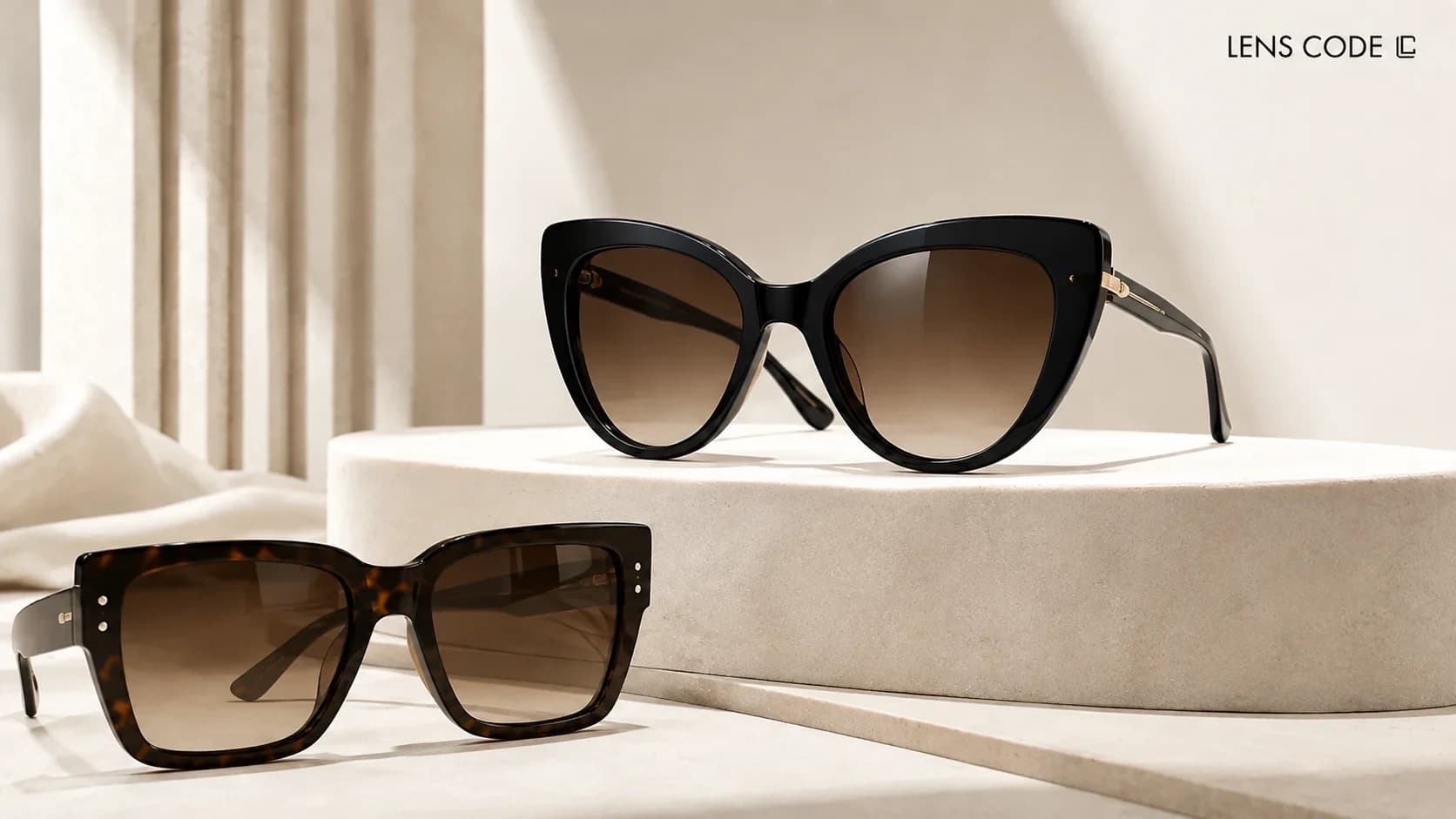
Women’s Sunglasses: Cat-Eye, Square or Aviator? How to Choose the Right Pair
If several pairs look good in the product grid, colour is not the best place to start. Cat-eye, square and aviator sunglasses can differ noticeably in lens shape, frame width, bridge proportions and temple length, even when the product photos make them look similarly sized.
Start with the LensCode Women’s Sunglasses collection , narrow the shape, then compare measurements between two or three frames. The wider Sunglasses collection is useful if you also want to consider unisex designs.
Quick answer
Choose the broad frame shape first, then check Lens Width, Bridge Width and Temple Length. Cat-eye frames emphasise their upper outer corners, square frames use straighter lines, and aviators have a distinctly different lens and bridge structure. Fit and lens specifications matter more than choosing a shape because it is labelled “for women”.
How do you narrow down women’s sunglasses by shape?
Use two rounds of filtering. First decide which shapes you genuinely want to compare. Then remove frames whose measurements or lens specifications do not suit your needs.
A practical order is: shape → measurements → proportions → lens specification → colour. That keeps you from choosing a colour first and then trying to make an unsuitable size work.
The current women’s range at LensCode includes cat-eye, square and geometric options, while the main sunglasses category gives you a broader view of the available shapes.
What defines cat-eye sunglasses?
A cat-eye frame is identified by the way its upper outer corners rise or extend beyond the main lens line. That feature can be subtle or pronounced, so two products carrying the same shape label can still look quite different.
LensCode currently lists WAHAJ inside its Saudi-English Women’s Sunglasses collection . Current LensCode product imagery identifies it as a women’s Cat-Eye YUVA sunglass with UV400 lenses.
I would compare the degree of corner extension and the overall width before worrying about black, tortoise or another colour. A stronger cat-eye outline changes the frame’s visual presence even if the measurements are close.
What do square sunglasses change visually?
Square sunglasses use straighter horizontal and vertical lines than a round or cat-eye design. Some are sharply angular; others soften the corners while keeping the overall square structure.
REEF is a useful current LensCode example. Its PDP identifies it as a YUVA Square frame for men and women with measurements 54-15-145, and the product description specifies UV400 lenses.
The useful comparison point is not “square is better than cat-eye”. It is whether a 54 mm lens width, 15 mm bridge and 145 mm temple sit closer to the proportions you already know work for you.
What about aviator sunglasses?
Aviators use a different lens silhouette from square and cat-eye frames and often make the bridge structure more visible. Many use a wider upper lens area with the lens narrowing towards the bottom.
Rather than relying on the Aviator label, compare lens width, lens height where available, bridge structure and total coverage. You can see current Aviator options within LensCode Sunglasses .
This article does not assign a specific Aviator product to the comparison table because the current LensCode product data I checked contains a gender-classification inconsistency on one of the obvious YUVA candidates. That is better left out than silently normalised.
Round, hexagonal and geometric frames
These shapes are useful when neither cat-eye nor square gives you the frame outline you want. A geometric lens makes its angles more visible, while a round design reduces straight edges.
PANENKA gives a current geometric example. LensCode lists it as a Hexagon YUVA sunglass for men and women, measuring 55-17-135, with UV400 lenses.
Compare those numbers with REEF : PANENKA is 1 mm wider at the lens, 2 mm wider at the bridge and 10 mm shorter at the temple. That is more useful shopping information than deciding from the word “geometric”.
Cat-eye vs square vs aviator sunglasses
| Shape | Visual structure | Measurements to watch | Check on the PDP |
|---|---|---|---|
| Cat-Eye | Raised or extended upper outer corners | Lens width and outer frame proportions | How pronounced the cat-eye outline actually is |
| Square | Straighter lines and a structured lens outline | Lens width, bridge and overall width | Whether corners are sharp or softened |
| Aviator | Wider upper lens area with a distinct bridge structure | Lens width, height, bridge and coverage | Bridge design and actual lens proportions |
| Geometric | More visible angles around the lens perimeter | Lens width, bridge and temple length | The actual cut of the lens rather than the category name alone |
If you specifically want rules based on facial proportions, keep that as a separate decision. LensCode already has a dedicated face-shape guide , so there is no need to turn every sunglasses comparison into another face-shape article.
Does oversized simply mean a wider lens?
No. A larger-looking frame is the result of several proportions, not one lens-width number.
Lens width matters, but so can lens height, bridge design, total frame width and the amount of material around the lenses. Two sunglasses with the same lens width can therefore look very different in scale.
Do not label a product “oversized” from a close-up photograph alone. If that description matters to your decision, use the actual PDP wording and measurements.
How should women’s sunglasses fit?
Start with a pair you already wear comfortably. Its numbers give you a practical baseline for online comparison.
Lens Width
Horizontal width of one lens.
Bridge Width
Space between the two lenses at the bridge.
Temple Length
Temple measurement from the hinge towards the ear.
The LensCode frame-size guide explains how to read these numbers and compare them with glasses you already own.
LensCode's FAQ also confirms that size numbers are normally printed on the inside of the temple of an existing pair.
What should you check when wearing sunglasses with a hijab?
Focus on the mechanics of the frame: temple thickness, side pressure, frame width and stability. The way a temple sits against the side of the head can feel different depending on both the frame and how the hijab is worn.
If you already have sunglasses that stay comfortable with your usual hijab, compare their temple length and general temple thickness with the new frame. The goal is stable positioning without unnecessary pressure at the sides.
Once you know the dimensions that work, return to Women’s Sunglasses and compare models within that range.
Is colour more important than fit?
No. Colour is a preference; fit determines whether the frame is practical to wear.
First remove options whose measurements are clearly unsuitable. Then use black, brown, tortoise or another available variant as the tie-breaker between frames that already pass the fit check.
What lens specifications should you review?
Keep this check short and product-specific. You do not need to rebuild the entire UV400-versus-polarized decision every time you compare two frames.
- • Verify the UV specification stated on the actual PDP.
- • Check the lens tint or lens colour if it is documented.
- • Treat Polarized as a product fact only when the page explicitly says so.
- • Recheck the selected variant before ordering.
REEF and PANENKA currently state UV400 on their LensCode PDPs. WAHAJ is also presented by LensCode with UV400 in its current Saudi catalogue imagery. Do not turn those three examples into a blanket claim for every product in the sunglasses collection .
How to compare women’s sunglasses at LensCode
These examples are chosen to show shape differences, not to rank the collection.
| Model | Classification | Shape | Measurements | Verified lens detail |
|---|---|---|---|---|
| WAHAJ | Women | Cat-Eye | Direct Saudi-English PDP measurements not surfaced in current verification | UV400 stated in current LensCode catalogue imagery |
| REEF | Men / Women | Square | 54-15-145 | UV400 |
| PANENKA | Men / Women | Hexagon | 55-17-135 | UV400 |
The table also shows why an honest data gap is better than an invented specification. WAHAJ is live in the current Saudi-English women’s collection, but I would not publish measurements for it until its direct Saudi-English PDP exposes them clearly.
All three examples sit within the current YUVA range. If you want the brand-level view before returning to the products, browse YUVA at LensCode .
Narrow by shape, then compare the numbers
Keep two or three frames on your shortlist and review each product page before deciding.
Browse Women’s SunglassesThree different frames, three different buying decisions
WAHAJ is the one to keep in the comparison when your starting point is a Cat-Eye outline. Its value here is the shape contrast with the other two, not a claim that Cat-Eye is universally better for women. You can find it in the current LensCode women’s collection .
REEF gives you a structured Square alternative at 54-15-145. Compare it if you want straighter lens lines without assuming that the gender label determines the fit.
PANENKA changes both shape and proportions. Its 55-17-135 measurements make the shorter temple length especially worth noticing beside REEF.
No model is the winner by default. The useful question is which shape and set of dimensions come closest to a pair you already know you can wear comfortably.
Women’s sunglasses online checklist
- Choose the broad frame shape first.
- Check whether the product is listed as Women or Unisex.
- Compare Lens Width.
- Compare Bridge Width.
- Compare Temple Length.
- Look at the overall frame proportions, not one measurement alone.
- Use only material information actually stated by the product.
- Verify the UV specification.
- Assume nothing about polarization unless it is explicitly documented.
- Confirm the selected colour or variant.
- Review the final PDP and current shopping terms before ordering.
If the size numbers are unfamiliar, revisit the size guide . You can also check LensCode FAQ and current terms and policies before returning to Women’s Sunglasses .
A 30-second sunglasses decision
Do not make colour your first filter
Start with shape, measurements and stability, then use colour to separate the frames that already work.
Compare Women’s SunglassesFrequently Asked Questions
How do I choose women’s sunglasses?
Choose a shape you actually want to wear, then compare lens width, bridge width, temple length and verified lens specifications before choosing the colour. Start with LensCode Women’s Sunglasses .
What is the difference between cat-eye and square sunglasses?
Cat-eye frames emphasise the upper outer corners. Square frames use straighter lines around the lenses. Actual dimensions still matter more than the shape label alone.
How should women’s sunglasses fit?
Compare Lens Width, Bridge Width and Temple Length with a comfortable pair you already own. The LensCode sizing guide explains how to read the measurements.
Are cat-eye sunglasses suitable for every face shape?
There is no need to treat face-shape rules as a guarantee. Size, comfort and personal preference still matter. LensCode has a separate face-shape guide if you want to explore that topic.
What sunglasses work well with a hijab?
There is no single best frame. Compare temple thickness, side pressure, frame width and stability with the way you normally wear your hijab.
Did you find this article helpful?
Share it with your friends or family interested in optical care.
فريق LensCodeVerified
A team specialized in optical sciences and eye care, dedicated to providing the latest information and advice to help you choose the perfect glasses and contact lenses.