


Choosing Glasses for Your Face Shape Starts With Proportion, Not Rules
If you have decided your face is round and now you are searching only for square frames, you are using half the information. Face shape can narrow the visual directions worth comparing, but it does not tell you whether the frame is the right width or whether the bridge will sit properly.
Use glasses for your face shape as a way to build a shortlist. Then use measurements and the actual PDP to decide which frames deserve to stay on it.
A quick visual starting point
These are comparison directions, not rules. A frame you like can still be worth considering if its proportions and measurements work for you.
How do you work out your face shape?
Look at four things: forehead width, the widest point around the cheekbones, jaw shape, and whether the face looks noticeably longer than it is wide. You do not need exact mathematical ratios.
- Round: softer curves with similar visual length and width.
- Oval: longer than wide with softer transitions.
- Square: a more defined jaw with stronger lines through the forehead and jaw.
- Long or rectangular: facial length is the most noticeable proportion.
- Heart: broader through the upper face with a narrower chin.
- Diamond: cheekbones tend to be the widest point.
Many faces sit between two categories. That is normal, and there is no reason to force yours into one label.
Face shape should narrow the shortlist, not make the final decision
Face shape tells you something about visual contrast. Actual frame fit depends on width, bridge design, temple length, rim thickness and how the finished frame sits.
Before rejecting a frame because its shape is supposedly “wrong” for your face, check the eyeglass frame size measurements . A sizing problem can easily be mistaken for a shape problem.
Pick two or three frame directions, then compare the measurements
Compare Eyeglass FramesWhat frames can you compare for a round face?
If you want stronger contrast against softer facial curves, compare rectangular, square, geometric or restrained cat-eye shapes. Straighter lines simply give you a different visual direction.
Round frames are not off limits. A small round frame and a wide round frame can look completely different, so check size before eliminating the shape itself.
What works differently with an oval face?
Oval proportions give you more shapes to compare: rectangular, round, geometric and cat-eye can all be reasonable starting points. That does not mean every frame fits.
A frame that is much wider than your face or a bridge that does not sit correctly remains a poor comparison, even if the shape looks balanced.
What should you compare with a square face?
Round, oval or softer geometric frames create a different visual contrast against a defined jaw and straighter facial lines. Aviator proportions can also be worth comparing.
If you prefer square frames anyway, compare rim thickness and width. A thin square frame does not have the same visual weight as a thick, wide one.
What matters with a longer or rectangular face?
Do not watch lens width alone. Lens depth and the vertical proportion of the front can change how substantial a frame looks on a longer face.
Compare a deeper frame against a vertically narrow one and decide which proportion you prefer. There is no universal lens-height number for every long face.
Heart and diamond face shapes
With a heart-shaped face, compare how much visual weight the frame places across the upper half. A lighter frame, oval shape or subtle cat-eye can give you useful alternatives.
With a diamond-shaped face, the cheekbones are often the widest point. Round, oval and gently lifted shapes are useful directions to compare rather than prescriptions you have to follow.
What if your face falls between two shapes?
Use the two strongest proportions instead of trying to win a face-shape quiz. If your cheeks are soft but your jaw is more defined, compare one curved frame and one angular frame. You will learn more from that comparison than from forcing one category.
Frame width can change the decision
A rectangular frame may give the visual contrast you want on a round face and still be too narrow. A shape that looks good cannot compensate for a bridge that does not sit securely.
Use the frame-size article to compare Lens Width, Bridge Width and Temple Length with glasses you already wear comfortably.
Frame shape is not frame material
Round, rectangular, cat-eye and geometric describe visual shape. Titanium, Acetate and TR90 describe materials. If material becomes part of your shortlist, use the frame materials comparison .
Frame shape is also different from frame construction
Round and cat-eye describe shape. Full-Rim, Semi-Rimless and Rimless describe how the lenses are held. Compare construction separately in Types of Eyeglass Frames .
Does the same face-shape advice apply to sunglasses?
The visual relationship between face and frame still matters, but sunglasses introduce coverage, lens specifications and intended use. Prescription glasses add their own lens and prescription decisions.
If the prescription is driving your choice, use the prescription glasses article . For sunglasses, start with the sunglasses collection .
WAHAJ is one live cat-eye sunglasses example. Use it to compare the shape and its 51-16-145 mm measurements, not as a rule for one face type.
Do men and women need different face-shape rules?
No separate visual rule is required. Men's and women's collection labels can make browsing easier, but individual face proportions, frame width, measurements and preference still decide the shortlist.
Compare the current eyeglasses collection or individual YUVA frames by shape and measurements rather than treating gender as a fitting rule.
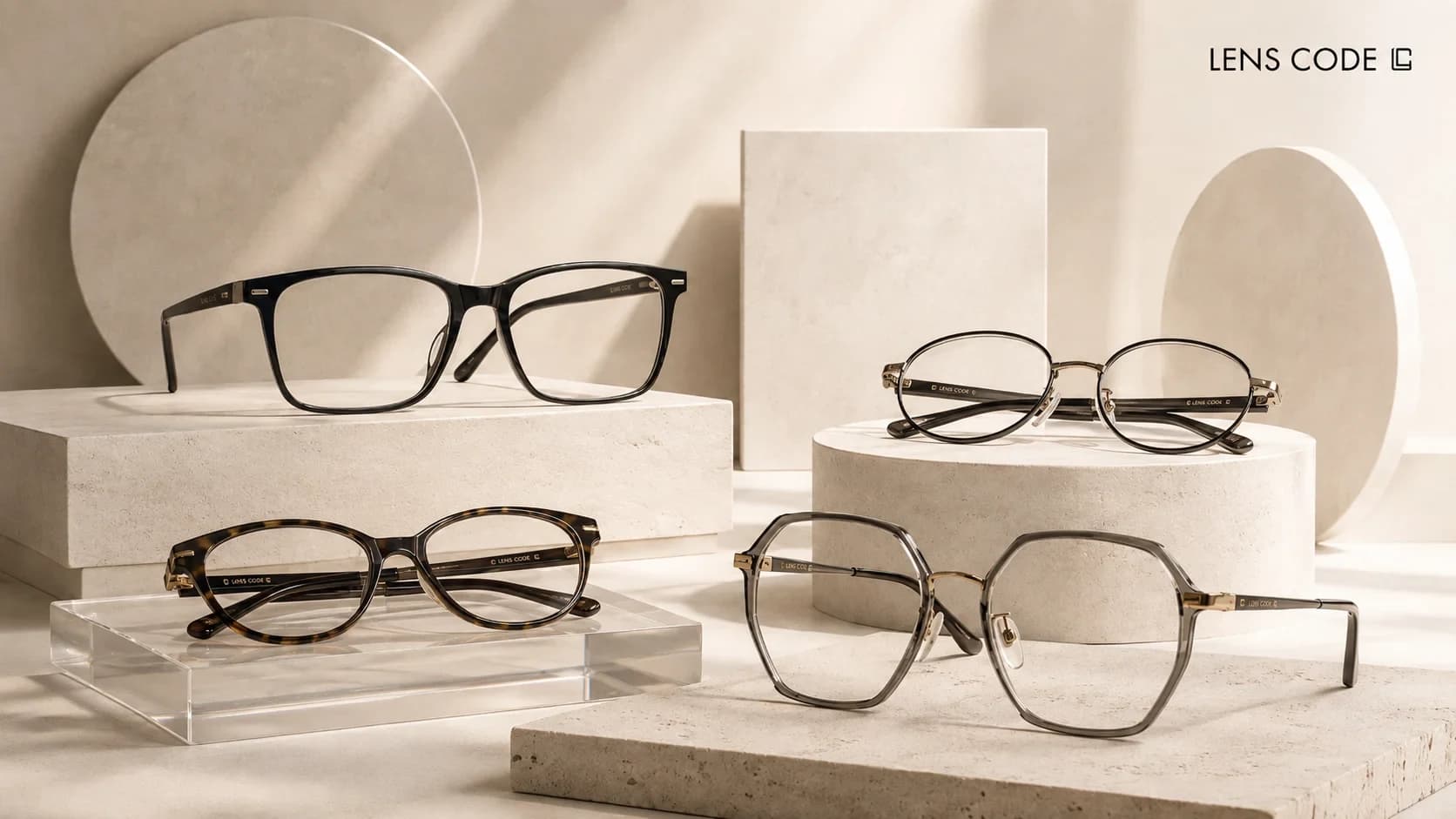
Compare actual LensCode frame shapes
These products are examples of different directions you can compare. None is assigned to one face shape only.
| Model | Listed shape / construction | Measurements | Why compare it? |
|---|---|---|---|
| Mira | Geometric; described as square with rounded edges | 51-17-144 mm | A useful example of more defined lines without completely sharp corners. |
| Rosa | Round | 48-18-143 mm | A clearly curved alternative to compare against angular frames. |
| Luca | Rectangular | 54-17-142 mm | Shows straighter proportions with a wider listed lens than Mira or Rosa. |
| Riva - Black | Cat-Eye | 50-18-138 mm | Useful if you want to compare a frame that rises visually toward the outer edges. |
| Vio - Bronze | Rimless | 52-19-140 mm | Shows why a construction label should not be treated as the same thing as frame shape. |
Angular frame versus curved frame
Compare Mira at 51-17-144 mm with Rosa at 48-18-143 mm.
The visual direction changes from geometric and square-with-rounded-edges to round, but the measurements change too. Mira has a 3 mm wider lens, a 1 mm narrower bridge and a 1 mm longer temple. Shortlist the shape you prefer, then compare those numbers with a frame you already know fits.
Frequently asked questions about glasses for face shape
What glasses suit a round face?
Rectangular, square and geometric frames are useful comparisons if you want stronger lines. Round frames are still valid if you like them and the size works.
What glasses suit an oval face?
Oval proportions allow a wider range of shapes, but frame width, bridge and measurements can still rule out a model.
Can a round face wear round glasses?
Yes. Angular frames create a different visual contrast, but round frames are not prohibited by face shape.
Does face shape matter more than frame size?
No. Face shape helps with visual direction. Measurements tell you whether the frame is practical enough to remain on your shortlist.
Do men and women need different frame shapes?
Not as a face-shape rule. Individual proportions, width, fit and preference matter more than the collection label.
Do not choose a frame from face shape alone
- ✓ Identify your strongest face proportions or the two closest face shapes.
- ✓ Shortlist two or three frame-shape directions.
- ✓ Compare Lens Width.
- ✓ Compare Bridge Width.
- ✓ Compare Temple Length.
- ✓ Check overall width if the PDP provides it.
- ✓ Keep frame shape, material and construction as separate decisions.
- ✓ Review prescription requirements if the order includes prescription lenses.
- ✓ Check the current PDP before ordering.
Once you have two or three candidates, use the online glasses pre-purchase checklist and the LensCode FAQ for the final order checks.
Start with shape, but do not end the decision there
Compare the visual direction you like with the actual measurements of the frame.
Compare LensCode FramesDid you find this article helpful?
Share it with your friends or family interested in optical care.
فريق LensCodeVerified
A team specialized in optical sciences and eye care, dedicated to providing the latest information and advice to help you choose the perfect glasses and contact lenses.