


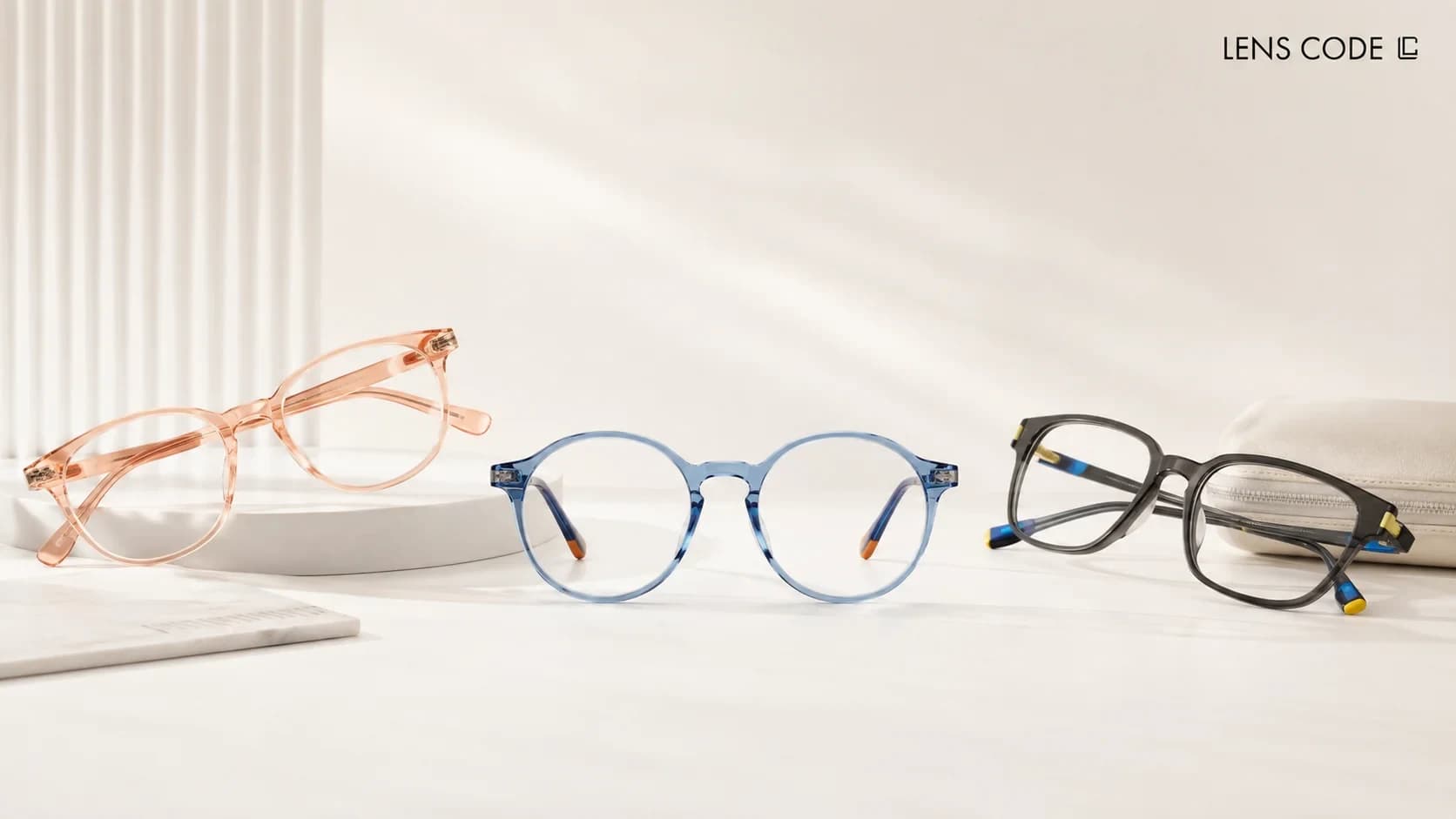
Kids' Glasses Frames: How to Choose the Right Fit, Material and Everyday Frame
Colour may be the first thing your child notices. Fit should be the first thing you check. A kids' frame needs to sit in the right position, stay reasonably stable during normal movement and match the child's face without uncomfortable pressure. Once that works, material, shape and colour become much easier decisions.
The short version
A well-fitting children's frame should stay in place without persistent slipping or uncomfortable pressure, keep the eyes appropriately positioned behind the lenses, and avoid unwanted contact with the cheeks or eyelashes. Check the frame measurements and stated material before deciding between colours or shapes.
What makes a kids' glasses frame fit properly?
Good fit is a combination of size, stability, eye position and frame construction. A frame does not become suitable simply because it appears in a children's collection.
Pediatric guidance from the American Association for Pediatric Ophthalmology and Strabismus recommends a comfortable frame with the eyes positioned appropriately within the lenses. It also advises that frames generally should not touch the child's cheeks or eyelashes.
For shopping, the most focused place to start is the LensCode Kids Eyeglasses collection . This keeps the comparison within children's prescription-frame options rather than mixing them with adult frames or kids' sunglasses.
How can you tell if your child's glasses are the right size?
Skip universal age-to-frame-size charts. Children's faces do not all grow at the same rate, and two frames with similar lens widths can fit differently because of their bridge, shape and temple construction.
- ✓ The eyes sit in an appropriate position behind the lenses rather than close to the frame edges.
- ✓ The bridge sits securely without repeatedly sliding down the nose.
- ✓ The frame does not create uncomfortable pressure around the nose or behind the ears.
- ✓ The temples reach and sit behind the ears without looking obviously too short.
- ✓ The frame does not rest against the cheeks or eyelashes in its normal position.
- ✓ Normal head movement does not make the glasses constantly fall out of position.
Three numbers are especially useful when comparing frames online: lens width, bridge width and temple length. If your child already owns a frame that fits well, its measurements give you a practical reference point for narrowing the next purchase.
The LensCode glasses size guide explains how to read these measurements and where to find them on an existing frame.
Signs a children's frame does not fit properly
If the glasses keep moving out of position, changing the colour or frame shape will not fix the underlying problem. Check fit first.
Recheck the bridge, overall frame width and temple fit.
The bridge, frame width or temple length may need a different fit or adjustment.
Recheck the frame size and how it is positioned on the child's face.
Do not assume this is normal simply because the frame is sold in a children's size.
How do you keep children's glasses stable during daily wear?
Start with the bridge and temples. Accessories should support an already sensible fit, not compensate for a frame that is clearly the wrong size.
AAPOS notes that some children use straps or temple tips—also called ear grips or ear locks—to help prevent glasses from sliding. Its guidance also notes that many children's frames use flexible arms. These are useful options when they suit the child, not requirements for every frame.
When comparing products, look at the actual dimensions rather than relying on the label “kids”. The full Kids Eyewear collection lets you see the current range before narrowing it to prescription frames.
What should you look for in a kids' frame material?
Start with the material that is actually listed for the frame. Do not identify a material from a product photo or assume that every flexible-looking frame uses the same polymer.
Several current LensCode kids' frames list TR90 as their frame material. Jouri, Candy and Diamond are three verified examples, and their current product information describes the frames as lightweight and flexible.
That does not mean every children's frame should automatically be described as TR90. If you want a broader comparison of titanium, acetate, TR90 and other frame materials, use the LensCode frame-material guide rather than turning a kids' fit decision into a materials catalogue.
Is TR90 the same as silicone?
No. Do not use TR90 and silicone as interchangeable product labels.
On the LensCode frames used in this guide, TR90 is listed as the frame material. Silicone may appear in a different part of the eyewear setup. AAPOS, for example, specifically refers to silicone temple tips that can help keep a child's glasses in position.
This matters because searches for “silicone kids glasses” can mix full frames with straps, temple tips and other flexible accessories. Check the product's material field rather than treating “silicone”, “flexible” and “TR90” as three ways of saying the same thing.
How important is frame shape?
Shape matters after the fit works. Current LensCode children's ranges include round, oval and rectangular designs, so you can still give your child a meaningful choice without using face shape as a rigid rule.
The YUVA kids' frames and ANDO kids' frames provide useful shape filters once you have narrowed the measurements.
How to compare kids' glasses at LensCode
Start with measurements and material, then compare shape and colour. That quickly removes frames that look appealing but do not match the dimensions you are trying to find.
| Frame | Brand | Material | Shape | Measurements | Colour |
|---|---|---|---|---|---|
| Jouri | YUVA | TR90 | Round | 47-18-136 | Transparent pink |
| Candy | ANDO | TR90 | Oval | 44-16-125 | Transparent red |
| Diamond | YUVA | TR90 | Rounded rectangular | 49-15-129 | Blue |
The useful difference here is not a ranking. Candy has the shortest temple and smallest lens width of the three examples. Jouri uses a wider bridge and longer temple, while Diamond has the widest lens and narrowest bridge of the group. Those numbers give you a more useful shortlist than colour alone.
All three current product routes include prescription-lens configuration, so you can review the frame first and then move into the lens-selection step.
Compare the frame before configuring the lenses
Check measurements, material and shape across a few models, then open the closest match and review its prescription-lens options.
Browse Kids' Eyeglass FramesKids' glasses online buying checklist
- ✓ Handle the child's prescription separately from the frame-style decision.
- ✓ Check lens width, bridge width and temple length.
- ✓ Compare the new frame with a well-fitting current pair when possible.
- ✓ Check how the bridge is expected to sit rather than using lens width alone.
- ✓ Confirm the listed frame material.
- ✓ Check that the product supports the prescription-lens configuration you need.
- ✓ Confirm the colour or variant before adding the frame to the order.
- ✓ Read the current returns and exchange conditions before custom lenses are prepared.
- ✓ Review the frame and prescription details once more before payment.
LensCode's FAQ covers frame sizing, prescription submission and returns. You can also check the current Terms & Policies before ordering prescription lenses cut specifically for the frame.
Everyday glasses are not automatically sports protective eyewear
A flexible everyday kids' frame should not automatically be treated as protective sports eyewear. For sports with a meaningful eye-injury risk, the frame and lenses need to be selected for that purpose.
AAPOS eye-safety guidance distinguishes sports frames from ordinary daily-wear glasses and recommends appropriate protective lenses for sporting activities.
A 30-second frame decision
If the measurements make sense, the frame stays in the right position and the material is clearly specified, narrow the choice to two or three models instead of comparing every frame in the category.
Start with fit, then narrow the style
Compare kids' frames by measurements, material and construction before moving to the prescription-lens step.
Explore Kids' Eyewear at LensCodeFrequently Asked Questions
How should children's glasses fit?
They should stay in position without persistent slipping or uncomfortable pressure, keep the eyes appropriately positioned behind the lenses and avoid unwanted contact with the cheeks or eyelashes.
What is the best frame material for kids' glasses?
There is no single material that suits every child. Check the material listed for the specific frame together with its measurements, construction and intended daily use.
What is TR90 in kids' eyewear?
TR90 is listed as the frame material on several current LensCode kids' models, including Jouri, Candy and Diamond. Check the individual product specification rather than assuming every kids' frame uses it.
Is TR90 the same as silicone?
No. They should not be treated as interchangeable labels. TR90 may be listed as a frame material, while silicone can refer to accessories such as temple tips or ear grips.
How do I stop my child's glasses from slipping?
Check the bridge and temple fit first. Some children may also use temple tips, ear grips or a strap when extra stability is useful.
Can prescription lenses be fitted to any kids' frame?
Do not assume compatibility from the frame shape alone. Check the product's lens configuration options and make sure the selected frame works with the child's prescription requirements.
Did you find this article helpful?
Share it with your friends or family interested in optical care.
فريق LensCodeVerified
A team specialized in optical sciences and eye care, dedicated to providing the latest information and advice to help you choose the perfect glasses and contact lenses.