


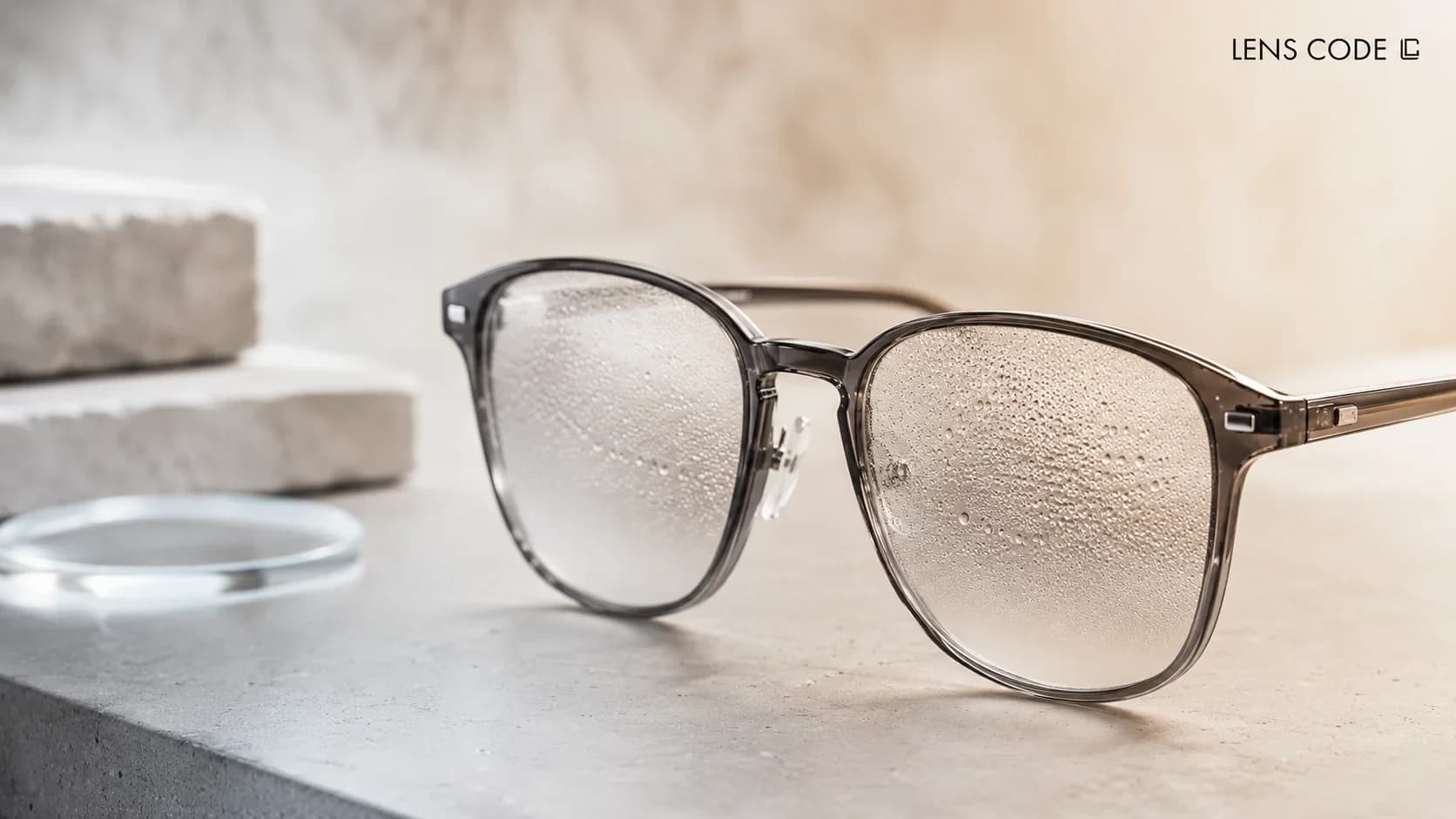
Why Glasses Fog Up When Temperature and Humidity Change
You step out of strong air conditioning into warm humid air and your lenses turn cloudy within seconds. In most cases, the lens has not failed. Moisture has condensed on the cooler surface and formed tiny droplets that scatter light.
If the fog clears as the lenses adjust to the surrounding temperature, that is a different problem from a lens that stays hazy after proper cleaning. I would separate those two situations before changing the lenses or putting another product on the coating.
Why do glasses fog up?
Glasses fog when moisture in warm, humid air condenses on a cooler lens surface. The resulting microscopic water droplets scatter light and make the lens look white or cloudy. Common triggers include moving out of air conditioning, warm breath, masks, steam, hot drinks and exercise.
Why do glasses fog up?
Fogging is mainly a surface-condensation problem. Warm air can contain moisture; when that moist air reaches a sufficiently cooler lens, some of the water vapour can condense into small droplets on the surface.
That does not mean the lens material itself has turned cloudy, your prescription has failed or the Anti-Reflection coating is automatically damaged. If haze remains after the temperature has settled and the lens has been cleaned correctly, compare that situation with persistent lens yellowing and cloudiness instead of continuing to treat it as ordinary fog.
Why do glasses fog when you leave air conditioning?
This is the temperature change that matters most in Gulf use. Your glasses can become noticeably cold inside an air-conditioned building or car. Walk into warmer, moisture-heavy outdoor air and that air suddenly meets a cooler lens surface.
Condensation can then form until the lenses move closer to the surrounding temperature. Humidity is not identical across Saudi Arabia or the GCC, so there is no reason to invent one regional percentage. The useful comparison is the temperature of the lens, the surrounding air and how much moisture that air contains.
Does every temperature change cause fogging?
No. A temperature change by itself does not guarantee fog. The surface and surrounding air still need to reach conditions where moisture condenses.
If your workday repeatedly moves between air-conditioned rooms and outdoor conditions, keep the fogging issue separate from your optical work-distance needs. Those belong in LensCode's office-glasses and working-distance article .
Why does a face mask fog glasses?
Warm exhaled air carries moisture. If part of that breath escapes upward around the nose and reaches cooler lenses, condensation can form there first.
A better seal around the upper edge of the mask can reduce the amount of breath directed toward the lenses where appropriate. The same physical mechanism explains why steam from cooking, hot drinks and some exercise conditions can fog a pair.
Do dirty lenses cause fogging?
Dirt and fingerprints do not create the temperature and humidity conditions that cause condensation. They can, however, make an already fogged lens harder to see through and change how moisture spreads across a greasy surface.
Cleaning is therefore useful, but it is not a cure for the physical trigger. If screen use rather than fog is the real source of visual discomfort, keep that question separate with the computer glasses versus prescription glasses comparison .
How should you clean fog-prone lenses?
Use a cleaning method that is compatible with the actual ophthalmic lens and its coatings. A clean microfiber cloth and a suitable optical-lens cleaner are safer starting points than experimenting with household products.
I would not put toothpaste, abrasive compounds, car-window cleaner, perfume or hairspray on a coated prescription lens. Even a mild soap recommendation needs to respect the lens manufacturer's care instructions rather than being presented as safe for every coating.
Not sure what treatment is already on your prescription lenses?
Check LensCode's current lens information before adding another surface product.
Check Current Lens InformationWhat does Anti-Fog actually do?
Anti-Fog does not remove humidity from the air. It changes how condensed moisture behaves on the optical surface so that it is less likely to remain as many separate light-scattering droplets.
Different products use different surface technologies. One verified example is ZEISS AntiFOG , which leaves a thin hydrophilic film on the lens. That describes a specific system; it should not be turned into a claim that every spray, wipe or permanent treatment works in exactly the same way.
Anti-Fog and Anti-Reflection are different
| Lens feature | Primary job | Does the name prove Anti-Fog? |
|---|---|---|
| Anti-Reflection | Reduces reflections from lens surfaces. | No. |
| Anti-Fog | Targets visible fog caused by condensed moisture. | It is specifically intended for fog management, with performance depending on the product. |
LensCode's current prescription-lens information states that its medical lenses include basic Anti-Reflection treatment. That does not establish that they include a dedicated Anti-Fog treatment as well.
If you are comparing Anti-Reflection with Blue Cut rather than Anti-Fog, use the Blue Light and Anti-Reflection guide because that is a different lens decision.
Is a hydrophobic coating the same as Anti-Fog?
No. Water repellency and fog management are different surface-performance concepts. A hydrophobic top coat is designed to make water less willing to remain on the surface and can make lenses easier to clean. That label alone does not prove Anti-Fog performance.
ZEISS separates its anti-reflective layers from water- and oil-repellent surface properties in its DuraVision coating system . This is why “hydrophobic” should not be used as another name for “Anti-Fog.”
Anti-Fog coating spray or wipe?
A spray or wipe is a surface treatment that generally needs reapplication according to that product's instructions. Other manufacturers may offer integrated or longer-term treatments.
There is no universal winner. Check coating compatibility, maintenance instructions and the actual performance claim for the specific product. LensCode's current public lens FAQ does not document a dedicated Anti-Fog lens option, spray or wipe, so this article does not invent one.
Why does fog return after you wipe the lenses?
Wiping removes the water already sitting on the surface. It does not remove the temperature-and-humidity conditions that created it.
If the lenses are still cooler than the moist surrounding air, condensation can form again. Allowing the lens temperature to move closer to ambient conditions may solve more than repeated wiping, but there is no useful universal number of seconds to promise.
When is cloudy vision not normal lens fog?
| What you notice | Temporary condensation | Lens surface worth checking |
|---|---|---|
| Appears after temperature, steam or humidity change | Typical | Not by itself a damage sign |
| Clears as conditions stabilise | Consistent with fog | — |
| Fixed haze after suitable cleaning | Less consistent | Check residue, scratches or coating condition |
| Permanent patches or visible surface damage | Not ordinary transient fog | Optical inspection makes more sense |
If cloudiness remains after the lenses reach the surrounding temperature and have been cleaned appropriately, stop treating it as condensation. LensCode's lens yellowing and coating-deterioration article covers persistent changes separately.
Does lens material determine whether glasses fog?
Do not use simple rules such as “polycarbonate never fogs” or “high-index lenses fog more.” Fogging depends heavily on surface temperature, environmental moisture and the surface treatment in use.
If lens design rather than fog is driving a replacement decision, move that comparison to LensCode's prescription glasses article instead.
Can frame fit affect fogging?
Frame position and airflow can change how easily warm moist breath reaches the lenses, but do not deliberately wear prescription glasses in a poor position to create more airflow.
If the frame itself sits incorrectly, compare the measurements using the Eyeglass Size Guide . Construction differences belong in Types of Eyeglass Frames , while the Frame Materials comparison handles material separately.
What should you do if your glasses fog every day?
- Identify the trigger: air conditioning, outdoor humidity, breath, mask or steam.
- Keep the lenses properly clean using coating-compatible care.
- Check whether exhaled air is being directed onto the lenses.
- If you need Anti-Fog, use a product confirmed as compatible with your lens and follow its instructions.
- Do not assume Anti-Reflection or a hydrophobic top coat means Anti-Fog.
- If haze remains without condensation conditions, have the lens surface inspected.
What should you check when buying another pair?
A new frame does not automatically solve condensation. Review fit, actual lens options and published coating specifications rather than looking for an “Anti-Fog frame.”
Before ordering, use the online glasses buying checklist and the prescription lens decision guide if the lenses themselves need replacing.
If the lenses need replacing rather than simply defogging, start with the frame and prescription decision
Browse LensCode EyeglassesQuick questions about foggy glasses
Why do my glasses fog when I leave air conditioning?
The cooler lenses meet warmer humid air, allowing moisture to condense into tiny droplets on the surface.
Do anti-reflective lenses prevent fogging?
No. Anti-Reflection primarily reduces lens-surface reflections. A separate Anti-Fog feature or treatment is needed if fog management is claimed.
Do dirty glasses fog more?
Dirt does not create the condensation trigger, but grease and residue can make a fogged lens harder to see through and change how moisture spreads.
Are Anti-Fog sprays safe for coated lenses?
Do not assume every product is compatible with every coating. Check the product instructions and the care requirements for your lens first.
Why are my lenses still cloudy after the fog clears?
Persistent haze can point to residue, scratches or coating deterioration rather than temporary condensation, so the lens surface may need inspection.
The 60-second fogging decision
For the current prescription-lens options, check the LensCode FAQ before ordering.
Did you find this article helpful?
Share it with your friends or family interested in optical care.
فريق LensCodeVerified
A team specialized in optical sciences and eye care, dedicated to providing the latest information and advice to help you choose the perfect glasses and contact lenses.