


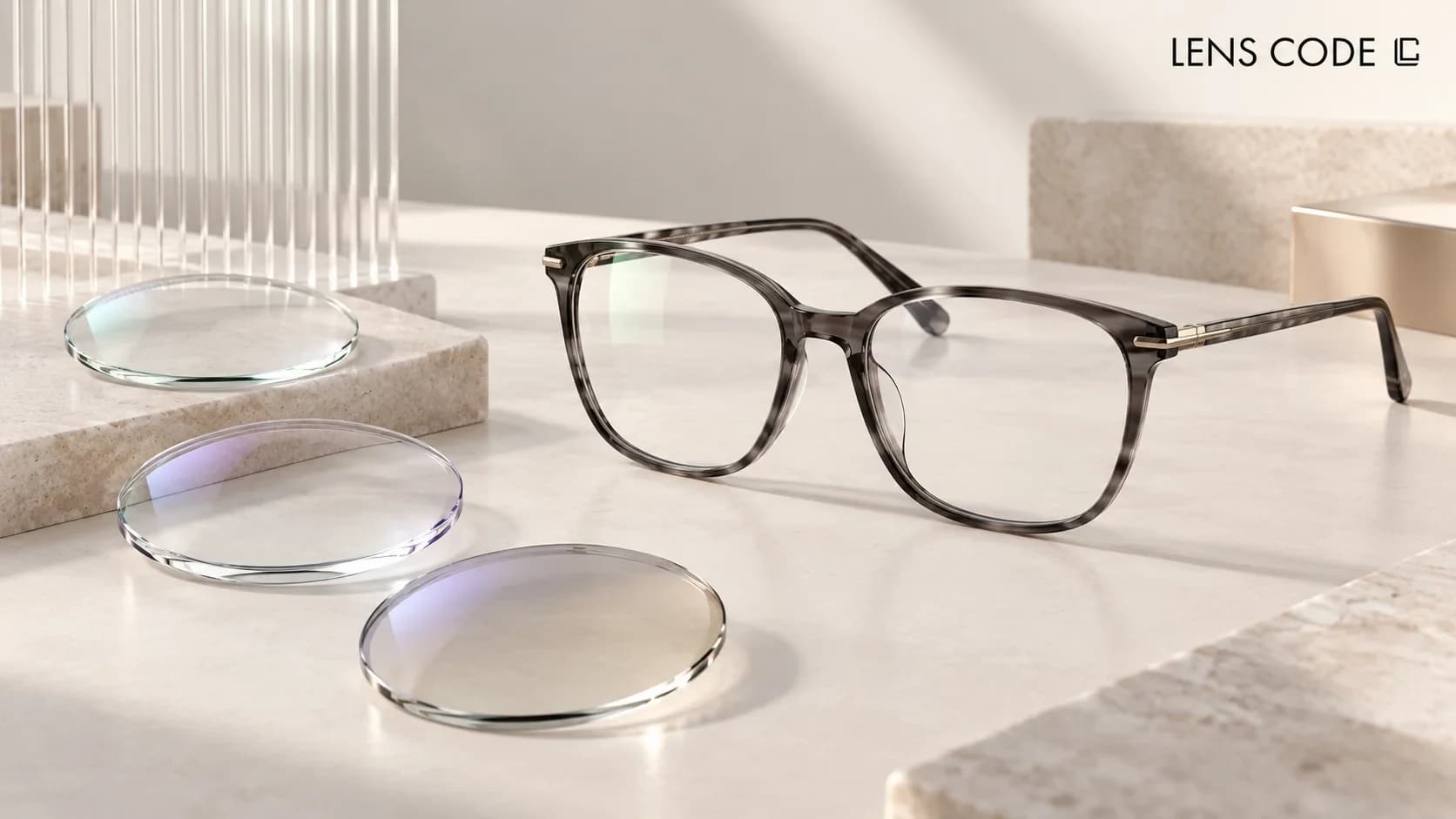
Types of Eyeglass Lenses and What Each Option Actually Changes
If a lens selector shows Single Vision, Progressive, High Index, Blue Cut and Photochromic together, those terms are not answering the same question. Some describe how your prescription works across viewing distances, while others describe the lens material or an added feature.
Separate those decisions first. Then it becomes much easier to compare a frame from LensCode Eyeglasses and review the lens configuration actually available for your prescription.
Quick answer
Eyeglass lens choices can be separated into three layers:
- Optical Design: how prescription correction is distributed across viewing ranges, such as Single Vision or Progressive.
- Material / Index: what the lens is made from and its refractive index.
- Treatment / Feature: additions such as Anti-Reflection, Blue Cut or Photochromic behaviour.
These layers can overlap. One finished lens may combine an optical design, a selected material and additional features if that specific lens configuration supports them.
Optical Design
Single Vision, Progressive, Bifocal or Office. Start here to define the viewing ranges the prescription needs to serve.
Material / Index
The lens material and refractive index. These interact with prescription and frame choice in the finished lens.
Treatment / Feature
Anti-Reflection, scratch resistance, Blue Cut and Photochromic behaviour. These do not define the prescription design.
What are the main types of eyeglass lenses?
The useful answer is not one flat list. First identify the optical design, then consider material or refractive index, and finally review treatments and features. For the wider prescription, frame, sizing and purchase decision, use the LensCode prescription glasses article.
Lens design, material and treatment are different decisions
| Decision | Examples | What it describes |
|---|---|---|
| Optical Design | Single Vision, Progressive, Bifocal | Viewing ranges and prescription zones |
| Material / Index | Standard plastic, Polycarbonate, Trivex, High Index | Material and refractive properties |
| Treatment / Feature | AR, Blue Cut, Photochromic | Additional lens behaviour or treatment |
What are Single Vision lenses?
Single Vision uses one primary prescription correction across the lens for one viewing range or purpose. That may be distance, near or another single visual requirement. Single Vision does not automatically mean distance-only glasses.
Are reading lenses different from Single Vision?
Not always. “Reading” often describes the near-vision purpose, while Single Vision describes the optical design. A prescription reading pair may therefore use Single Vision near correction. Do not choose a reading power from age or symptoms alone.
How do Progressive lenses differ from Single Vision?
Progressive is a multifocal design with zones for distance, intermediate and near vision without the visible line used in traditional bifocals. It is not automatically better than Single Vision. Prescription needs, fitting and adaptation still matter. See wearing glasses throughout the day for task-specific use considerations.
Where do bifocals and other multifocals fit?
Bifocals are a traditional multifocal design with defined viewing areas, usually separated by a visible segment line. They are a market lens category; mentioning them here does not confirm current LensCode availability unless they appear in the live lens configuration.
Where do Office and Occupational lenses fit?
Occupational designs commonly prioritise near and intermediate work distances. They should not automatically be treated as general-distance or driving lenses. For the deeper decision, use the Office Glasses article or compare prescription and computer glasses.
What is the difference between lens design and lens material?
Optical design determines how correction is arranged. Material describes what the lens is made from and its physical and optical properties. Standard ophthalmic plastics, Polycarbonate, Trivex and higher-index materials belong to this second layer, not to the Single Vision-versus-Progressive decision.
Does High Index mean a better lens?
No. High Index refers to a higher refractive index, not a quality score. It may help manage lens thickness in some prescriptions, but the finished result also depends on prescription, lens diameter, frame size and shape, centration, material density and lens design.
How can frame size affect the finished lens?
Frame dimensions and shape influence the lens area that must be finished and fitted. That can affect thickness, weight and positioning alongside the prescription and material. Compare the LensCode frame size guide and eyeglass frame types.
Anti-Reflection is a treatment, not a prescription design
Anti-Reflection primarily reduces reflections from lens surfaces. It does not determine whether the lens is Single Vision or Progressive. LensCode's current lens FAQ also lists basic anti-reflective and scratch-resistant treatment. Scratch-resistant does not mean scratch-proof. For AR versus Blue Cut, see the Blue Light lens guide.
Blue Cut is a filtering feature, not a lens-design category
Blue Cut describes blue-light filtering. It does not tell you whether the prescription is Single Vision or Progressive, and it should not be treated as a proven treatment for computer eye strain. LensCode covers the clinical evidence separately in Do Blue Light Glasses Protect Your Eyes?
Where do Photochromic lenses fit?
Photochromic describes light-responsive lens behaviour rather than prescription power. The tint changes with relevant light conditions according to the technology used. Do not assume every product changes at the same speed, reaches the same tint or behaves identically inside a car.
Can a lens be Progressive, Photochromic and Anti-Reflective?
Conceptually, yes. Progressive describes optical design, Photochromic describes light-responsive behaviour, and Anti-Reflection describes a surface treatment. They are different layers of the finished lens. The actual combination still needs to be supported by the selected product configuration.
How do SPH, CYL, AXIS and ADD relate to the lens decision?
SPH describes spherical prescription power. CYL and AXIS relate to astigmatism correction, while ADD records additional near power when required. These are prescription values, not premium lens features. Do not alter them yourself; LensCode's current prescription terms require accurate prescription details.
How should you work through the LensCode lens decision?
Lens check before ordering
- ✓ Your current prescription details are clear.
- ✓ You know which viewing distances need correction.
- ✓ You have identified the optical design.
- ✓ You have reviewed Material / Index if offered.
- ✓ You have reviewed treatments and features separately.
- ✓ You have checked frame and fitting compatibility.
- ✓ You have confirmed the live LensCode option before custom production.
LensCode currently allows prescription information to be supplied during the prescription-glasses journey. Check the current prescription FAQ, custom-lens terms and online glasses buying checklist before confirming a customised order.
Quick comparison of common lens terms
| Term | What it describes | Primary role | Can it combine with other options? |
|---|---|---|---|
| Single Vision | Optical design | One correction range | Yes |
| Reading | Near-purpose configuration | Near tasks | Yes |
| Progressive | Multifocal design | Distance + intermediate + near | Yes |
| High Index | Material / index | Material and lens-form considerations | Yes |
| Anti-Reflection | Treatment | Reduce surface reflections | Yes |
| Blue Cut | Filtering feature | Filter selected blue light | Product-dependent |
| Photochromic | Light-responsive behaviour | Adaptive tint | Product-dependent |
Common mistakes when comparing eyeglass lenses
If discomfort starts after a new pair, do not solve it by changing prescription values yourself. Use the LensCode new-glasses troubleshooting article to understand what needs checking.
The 60-second lens decision
Prescription
Required Viewing Distances
Optical Design
Material / Index
Treatments / Features
Frame / Fitting Compatibility
Verify the Current LensCode Configuration
Order
If you still need to choose the whole pair rather than the lens alone, return to the complete prescription glasses decision.
Frequently asked questions about eyeglass lens types
What are the main types of eyeglass lenses?
Separate them into optical design, material or refractive index, and treatments or features. These categories describe different parts of the finished lens.
What is the difference between Single Vision and Progressive?
Single Vision provides one correction range. Progressive is a multifocal design with distance, intermediate and near zones.
Are reading lenses Single Vision?
They can be. “Reading” often describes the near-use purpose, while Single Vision describes the optical design.
What does High Index mean?
It refers to the refractive index of the lens material. A higher number is not automatically a better lens for every prescription.
Is Anti-Reflection a type of prescription lens?
No. It is a treatment that reduces reflections from lens surfaces and does not determine the prescription design.
Is Blue Cut a prescription lens type?
No. Blue Cut is a filtering feature. See the Blue Cut and Anti-Reflection comparison for the deeper buying decision.
Which eyeglass lens type is best?
There is no universal best. The appropriate choice depends on the prescription, required viewing distances, frame and the lens configuration actually available.
Choose the correction first, then review the add-ons
Once you know the optical design you need, compare LensCode Eyeglasses and review the lens options currently available for your prescription before confirming the order.
Did you find this article helpful?
Share it with your friends or family interested in optical care.
فريق LensCodeVerified
A team specialized in optical sciences and eye care, dedicated to providing the latest information and advice to help you choose the perfect glasses and contact lenses.